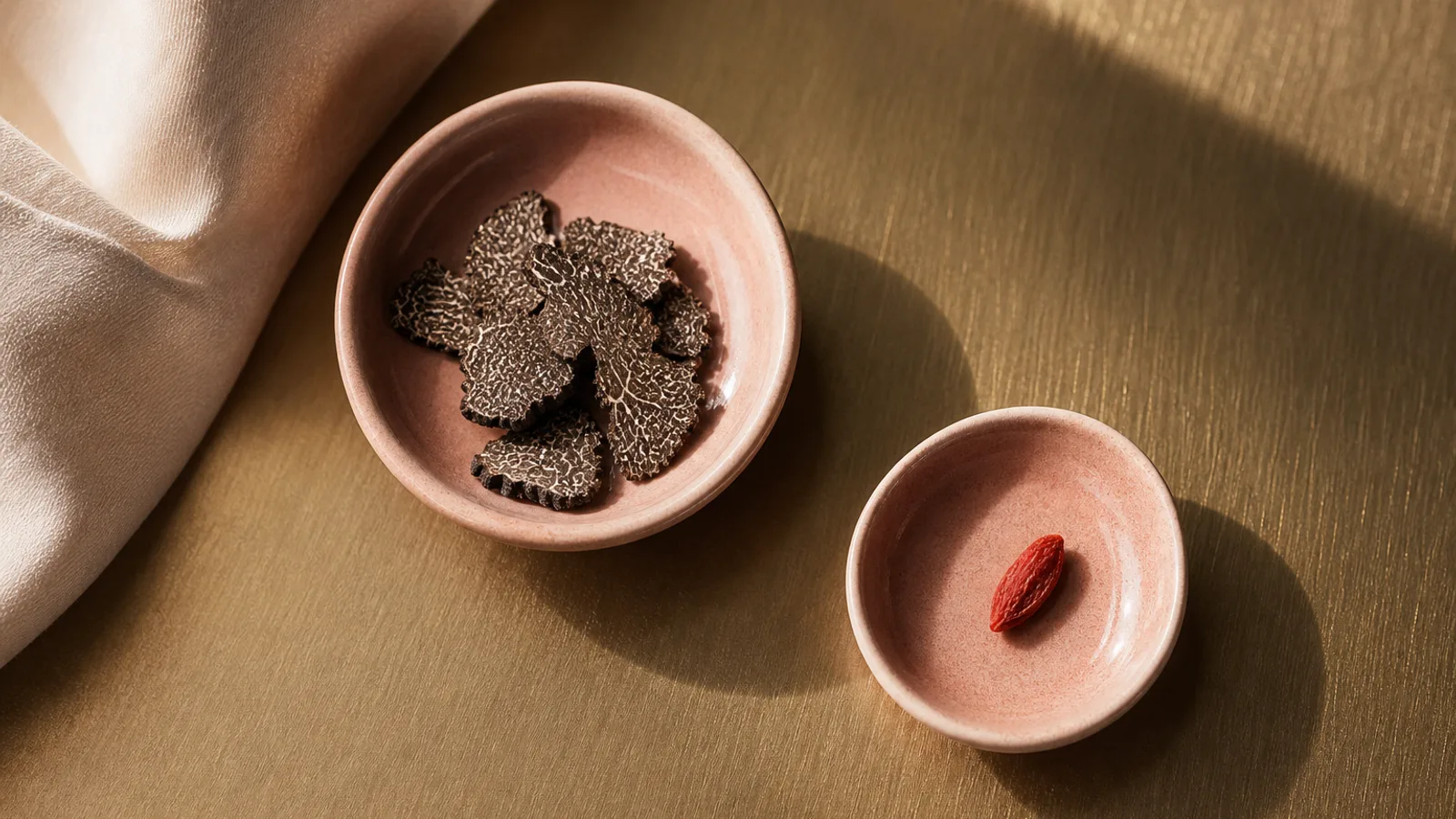
Unlocking the Power of Truffle Skincare: A Deep Dive into Key Active Ingredients

Unlocking the Power of Truffle Skincare: A Deep Dive into Key Active Ingredients

Truffle skincare combines polysaccharides that support hydration, antioxidants that help limit oxidative stress, and amino acids that support the skin's natural moisturising system. Their value depends on extraction, concentration, stability and delivery. Bio-fermentation can break complex compounds into smaller fractions, but the finished formula and supporting evidence determine whether they work.

Truffle is often treated as a luxury label rather than a biochemical ingredient. That misses the useful question. What compounds does the extract contain, how has it been processed, and can the finished formulation deliver them in a form the skin can use?

This key active ingredients breakdown examines polysaccharides in truffle, antioxidants in truffle and amino acids in truffle. It also explains why molecular size, fermentation, formulation quality and clinical evidence matter more than an exotic ingredient name.

Key takeaways

  • Truffle extracts can contain polysaccharides, antioxidant compounds and amino acids, but their composition varies by species, harvest and extraction method.
  • Polysaccharides mainly support hydration through water binding and surface film formation.
  • Antioxidants help defend against oxidative reactions, although their effectiveness depends on stability and concentration in the finished product.
  • Amino acids contribute to skin hydration and barrier function, while peptides may also have signalling roles depending on their sequence and delivery.
  • Being smaller than 500 Daltons may improve passive penetration potential. It does not prove that an ingredient reaches the dermis or produces structural change.
  • Clean, ethical and safe are not interchangeable scientific terms. Ingredient transparency, testing and defensible claims provide better guidance.

Summary table

Active groupPrimary skincare roleWhat determines performanceMain limitation
PolysaccharidesWater binding, film formation and surface comfortMolecular structure, concentration and formulationOften acts mainly near the skin surface
AntioxidantsHelps limit oxidation caused by reactive moleculesCompound identity, stability, packaging and doseUnstable antioxidants can lose activity before use
Amino acidsSupports natural moisturising factors and water balanceAmino acid profile, pH and compatibilityPresence alone does not prove a clinical effect
PeptidesMay support hydration or cellular signallingSequence, size, dose, stability and deliveryA peptide label reveals little about bioavailability
Fermented truffle fractionsCan produce smaller compounds and new metabolitesOrganism, time, purification and quality controlsFermentation does not automatically guarantee penetration

What counts as an active ingredient in truffle skincare?

An active ingredient is a component included to produce a defined effect, such as hydration, antioxidant protection or improved skin feel. In truffle skincare, the useful actives are not simply "truffle". They are the characterised polysaccharides, phenolic compounds, amino acids, peptides and fermentation metabolites present in a properly standardised extract.

The word "active" also has a regulatory context. In Australia, cosmetics and therapeutic goods are treated differently. A moisturiser can claim to hydrate or improve appearance. Claims to treat disease, alter physiological processes or produce therapeutic outcomes can bring a product within the therapeutic goods framework.

The Therapeutic Goods Administration explains this distinction in its guidance on cosmetics and therapeutic goods. A premium ingredient does not exempt a brand from substantiating its claims.

A credible ingredient assessment therefore starts with five questions:

  1. What truffle species or fermentation material was used?
  2. Which compounds have been identified in the extract?
  3. How was the ingredient extracted, fermented and purified?
  4. What concentration appears in the finished formula?
  5. Was the finished product tested, or only the raw ingredient?

That final distinction is routinely overlooked. A raw material may perform well under laboratory conditions while the retail product uses a different concentration, delivery system or supporting formula. Ingredient evidence is useful, but finished-formula evidence is stronger.

INCI lists also require context. Ingredients generally appear in descending order until the list reaches components present at low concentrations. Position can offer a clue, but it cannot reveal an exact dose. Some potent ingredients work at low levels, while an extract near the top of a list may still be chemically weak or poorly standardised.

Key active ingredients breakdown: what is inside truffle extract?

Truffle extract divided into five active ingredient groups

Truffle extracts may provide several active groups rather than one isolated hero compound. Polysaccharides primarily support moisture retention, antioxidant compounds help manage oxidative stress, and amino acids contribute to the skin's natural moisturising system. Fermentation may also generate smaller peptides and metabolites, creating a broader functional profile than an unprocessed extract.

The word "may" matters. Truffles are biological materials. Their chemistry varies with species, maturity, soil, climate, storage and processing. Two products carrying the same truffle marketing language can therefore have materially different compositions.

Polysaccharides in truffle

Polysaccharides are long carbohydrate chains. In a topical formula, many function as humectant or film-forming materials. They can attract or retain water around the stratum corneum, then create a light surface layer that slows moisture loss and improves softness.

This can produce meaningful comfort for dry or tight skin. It should not, however, be confused automatically with dermal remodelling. A polysaccharide can improve measured hydration without entering the deeper skin layers. That is still valuable. Barrier hydration is a legitimate outcome, not a lesser one.

The performance of a truffle polysaccharide depends on:

  • chain length and branching
  • solubility in the formula
  • affinity for water
  • interaction with lipids and other humectants
  • resistance to degradation during storage
  • the amount retained after cleansing or environmental exposure

Polysaccharides often work best as part of a hydration system. Humectants hold water, emollients smooth gaps between surface cells, and occlusive components reduce evaporation. A formula that uses only one part of that system may feel impressive on application but fail to sustain comfort.

For reactive skin, film-forming polysaccharides may also reduce the sensation of roughness. They are not medicines for redness, eczema or rosacea. Persistent inflammation requires professional assessment rather than cosmetic trial and error.

Antioxidants in truffle

Antioxidants donate electrons or otherwise interrupt oxidation reactions involving reactive molecules. In skincare, that matters because ultraviolet exposure, pollution and normal cellular activity can contribute to oxidative stress. Oxidative stress can affect lipids, proteins and other structures associated with healthy-looking skin.

Truffles can contain antioxidant-associated compounds, including phenolic fractions. Yet "contains antioxidants" is only the beginning of the analysis. An antioxidant needs to remain stable through extraction, manufacturing, transport, storage and repeated opening of the package.

Four practical variables decide whether antioxidant positioning is credible:

  • Identity: The brand should know which antioxidant compounds or fractions are present.
  • Standardisation: Batch composition should remain reasonably consistent.
  • Stability: The compounds must survive inside the product for its intended shelf life.
  • Packaging: Airless or low-exposure packaging can help protect oxidation-sensitive formulas.

An antioxidant test performed in a laboratory solution does not prove an anti-ageing result on human skin. Chemical assays can show free-radical scavenging capacity, but human outcomes require well-designed use testing or clinical evaluation of the finished product.

Antioxidants should also complement, not replace, sun protection. In Australia, daily sunscreen remains the more direct defence against ultraviolet exposure. No antioxidant serum compensates for inadequate sunscreen use.

Amino acids in truffle

Amino acids are small organic compounds used throughout human biology. In the stratum corneum, free amino acids and their derivatives form part of the natural moisturising factor, a collection of water-attracting substances that helps maintain flexibility and hydration.

Topical amino acids can support a moisturising formula by helping bind water. Different amino acids have different chemical behaviour, so an amino acid profile is more informative than a generic total.

Amino acids are also the building blocks of peptides and proteins. That does not mean applying amino acids directly creates new collagen. Collagen synthesis is a regulated cellular process. A cosmetic formula must influence the relevant biological pathway, at an effective dose and location, before a structural claim becomes plausible.

This is where marketing frequently skips several steps. "Contains amino acids" becomes "builds collagen" without evidence connecting the ingredient, formulation, penetration and human outcome. Those are separate propositions.

Peptides and fermentation metabolites

Peptides are short chains of amino acids. Their behaviour depends on sequence, charge, size and chemical modification. Some mainly condition the surface. Others are investigated as signalling compounds. Treating every peptide as interchangeable is scientifically weak.

Fermentation can change a truffle substrate by breaking larger materials into smaller fractions and producing new metabolites. The result depends on the microorganism, fermentation conditions, duration, temperature, purification and quality controls. A fermented label alone says nothing about consistency.

Truffelle's approach uses a 90-day bio-fermentation process for Australian Black Truffles grown in the Barossa Valley. The brand describes the resulting material as a bioavailable peptide concentrate. To evaluate that proposition properly, the questions remain the same: What molecular fractions are produced, how consistent are they, and what does testing of the finished formulation show?

How do truffle actives work together?

Skin diagram showing the roles of truffle active ingredients

Truffle actives work best as a coordinated system. Polysaccharides improve surface hydration, amino acids support water balance, antioxidants help protect vulnerable formula and skin components, and selected peptides may provide additional signalling or conditioning effects. The supporting emulsion then controls stability, contact with the skin and release of those compounds.

A useful way to understand the combination is to separate immediate, intermediate and longer-term outcomes.

Immediate surface effects

Humectant and film-forming compounds can make the skin feel softer and less tight after application. Emollients improve slip and smooth visible flaking. These results may occur quickly because they do not require extensive biological change.

Immediate softness is not proof of structural repair. Silicones, oils and film formers can all create a smooth finish. That finish may be desirable, but it should not be presented as evidence that collagen has increased.

Barrier-support effects

Consistent hydration can help the stratum corneum remain flexible. A formula containing compatible lipids, humectants and soothing components may also reduce avoidable moisture loss. These effects depend on routine consistency and the broader formula, not truffle extract alone.

Truffelle calls its coordinated formulation model "The Master Key". It has three parts:

  • Barrier Fortification: supporting the lipid matrix and ceramide environment to limit transepidermal water loss.
  • Microbiome Harmony: using compatible prebiotic ingredients and peptides without treating the microbiome as a single organism.
  • Dermal Delivery: preparing smaller molecular fractions intended to improve access beyond surface-level deposition.

The framework is useful because it stops ingredient analysis becoming a shopping list. Skin outcomes come from interactions between the active, vehicle, barrier and usage pattern.

Potential structural effects

Claims involving elasticity, wrinkle depth, collagen or dermal thickness require stronger evidence. The finished product should ideally be assessed using defined instruments, an appropriate control, sufficient participants and transparent reporting.

Hydration can temporarily alter the appearance of fine lines. That is not the same as increasing collagen. Likewise, a firmness rating reported by users measures perception, while ultrasound imaging, cutometry and validated wrinkle imaging assess different physical endpoints. Results cannot be substituted for one another.

Why molecular size and bio-fermentation matter

Bio-fermentation process producing smaller truffle peptide fractions

Molecular size affects passive movement through the skin, but it is not a penetration guarantee. The widely cited 500 Dalton rule proposes that compounds above this molecular weight rarely cross intact skin efficiently. Charge, solubility, vehicle, concentration and barrier condition also matter, so sub-500 Dalton size is a gateway rather than proof of dermal delivery.

Bos and Meinardi described this principle in their paper, "The 500 Dalton rule for the skin penetration of chemical compounds and drugs". The rule is a useful formulation filter. It should not be turned into a simplistic promise that every smaller molecule reaches a particular cell or triggers a clinical response.

Many proteins and long peptide chains are too large for efficient passive penetration through intact stratum corneum. Smaller peptide fragments may have better prospects, but molecular weight is only one parameter. Hydrophilic compounds can still struggle to cross lipid-rich regions, while highly lipophilic compounds can become retained within them.

This is why delivery requires more than reducing size. A formulator must consider:

  • molecular weight distribution
  • electrical charge
  • oil and water solubility
  • product pH
  • peptide stability
  • interaction with emulsifiers and lipids
  • release from the vehicle
  • skin contact time

Truffelle's Bio-Fermentation Process has three defined phases.

Phase 01: The Harvest

Black truffles are hand-harvested at peak maturity from a growing site within an ancient meteor crater in the Barossa Valley. Biological maturity matters because the source material's chemistry can change across development and storage.

Phase 02: The Fermentation

The truffles undergo a 90-day controlled biological breakdown. Truffelle's purpose is to reduce complex compounds and generate new bioactive metabolites. Process control matters here. Fermentation time alone does not establish quality unless temperature, organisms, contamination controls and endpoint specifications are also managed.

Phase 03: The Activation

The resulting concentrate is incorporated when Truffelle considers it to have reached peak cellular compatibility. Small seasonal batches are poured within 72 hours of fermentation completion to preserve what the brand calls batch-fresh potency.

This process is the basis for Truffelle's phrase, "where other creams end, we begin". The defensible interpretation is not that all conventional creams fail. It is that ingredient sourcing without delivery engineering is incomplete.

What does the available Truffelle evidence show?

Truffelle's supplied clinical materials report improvements in hydration, elasticity, collagen-associated measurements, wrinkle depth and dermal thickness. These figures are more useful than general ingredient claims because they concern measurable endpoints. They still need to be read with the trial design, participant details, controls, methods and statistical analysis before broad conclusions are made.

Reported endpointResult reported in Truffelle's supplied materialsTesting context supplied by TruffelleSource
Hydration+48%Truffle extract studies referenced by the brandTruffelle clinical dossier, referencing Phenbiox and University of Bologna work
Skin elasticity+35%Truffle extract studies referenced by the brandTruffelle clinical dossier, referencing Phenbiox and University of Bologna work
Collagen production+30%Clinical research referenced by the brandTruffelle clinical dossier
Wrinkle depth-12.8%42-day human trialTruffelle clinical dossier, referencing Phenbiox and University of Bologna work
Dermal thickness+0.39 mm42-day trial using ultrasound imagingTruffelle clinical dossier

These are the brand's supplied figures, not independently verified conclusions in this article. The difference matters. Before comparing them with another product, check whether both studies used similar participants, climates, baseline conditions, instruments and endpoints.

For example, a percentage improvement in hydration cannot be compared directly with a change in wrinkle depth. Nor can an ingredient supplier study automatically substantiate the exact retail formula if concentration or formulation differs.

The strongest evidence hierarchy for a cosmetic product is usually:

  1. objectively measured testing of the finished product on human participants
  2. a controlled comparison against the vehicle or a credible alternative
  3. transparent reporting of methods and participant numbers
  4. stability and compatibility testing
  5. raw ingredient studies that support the proposed mechanism
  6. laboratory antioxidant or cell-based assays
  7. consumer testimonials and before-and-after photographs

Testimonials can reveal tolerability and perceived benefit. They cannot isolate cause or predict an average response.

A verified customer, Eleanor M., reported that longstanding redness began to subside within two weeks of using Truffelle's Black Diamond Duo. She described it as feeling like medicine for her skin barrier. That is her subjective experience, not evidence that the product treats a medical condition.

Another verified customer, Victoria R., replaced a six-step routine with Truffelle products. She reported softer fine lines around her eyes and renewed bounce. Her experience supports a practical point: adding more products is not automatically better. It does not establish how every skin type will respond.

Choosing truffle actives for your skin concern

Choose truffle skincare by matching the formula's demonstrated function to your concern, not by selecting the most luxurious ingredient story. Dry skin needs a complete hydration and lipid system. Dull or environmentally exposed skin may benefit from stable antioxidants. Sensitive skin needs a short, fragrance-conscious formula with careful introduction and realistic claims.

Dry or dehydrated skin

Look for polysaccharides and amino acids alongside established humectants, emollients and barrier lipids. Dehydration refers to water content, while dry skin commonly involves insufficient surface lipids. Many people experience both.

A water-rich serum can improve hydration but may need a cream over it to reduce evaporation. In dry Australian conditions, application to slightly damp skin followed by an appropriate moisturiser can be more useful than repeatedly adding serums.

Sensitive or reactive skin

A rare natural ingredient can still cause irritation. Review the entire INCI list for fragrance, essential oils, exfoliating acids and other ingredients that have caused previous reactions. Patch testing is sensible, particularly when the skin barrier is already unsettled.

Introduce one product at a time. Apply it consistently before adding another. If redness, burning, swelling or persistent itching develops, stop using it. Seek medical advice for severe or recurring symptoms.

Fine lines and loss of firmness

Separate dehydration lines from deeper structural changes. A strong moisturising system can quickly soften lines caused by surface dryness. Claims involving collagen, elasticity or dermal thickness need instrument-based finished-product evidence.

Do not judge a formula solely by whether it contains peptides. Ask which peptides, at what characterised size, using what delivery system, and with what human testing. Peptide count is not a meaningful performance measure.

Dull or uneven-looking skin

Antioxidants can support a routine aimed at maintaining a brighter, healthier appearance. Sunscreen is still fundamental. Exfoliating acids may improve surface texture, but aggressive layering can impair tolerance and create the very dullness the routine was meant to address.

This is where fewer, better actives become practical rather than minimalist theatre. Remove redundant steps. Keep products that serve a defined role and can be used consistently.

Oily or blemish-prone skin

Truffle actives are not substitutes for evidence-based acne treatment. A lightweight formula may support hydration without a heavy finish, but acne claims must be treated carefully under Australian regulation.

People using prescription acne treatments or strong over-the-counter actives should introduce supplementary products cautiously. A dermatologist or pharmacist can help assess interactions and irritation risk.

Are clean, ethical and natural claims meaningful?

Clean, ethical and natural are not interchangeable measures of safety or performance. "Clean" has no single universal cosmetic definition, natural materials can irritate, and synthetic ingredients can be safe and highly characterised. A credible brand should publish specific formulation standards, sourcing practices, testing methods and exclusions rather than relying on an undefined halo term.

Safety is determined by identity, dose, exposure, purity and use conditions. An ingredient is not safe merely because it comes from the earth, and it is not harmful merely because it was synthesised.

The same discipline applies to claims about endocrine disruption. A broad "free from endocrine disruptors" statement requires a defined exclusion policy, supplier documentation and ongoing review. It should not imply that every competing synthetic ingredient disrupts hormones.

Ethical truffle skincare should address:

  • traceable source material
  • responsible harvesting and land management
  • controls against contamination and adulteration
  • supplier labour standards
  • realistic batch and shelf-life management
  • recyclable or reduced packaging where feasible
  • evidence supporting environmental statements

The ACCC's guidance on environmental claims is relevant to Australian skincare brands. Businesses must be able to substantiate sustainability claims and avoid broad statements that create a misleading overall impression.

"Non-toxic" is another weak shortcut. Toxicity depends on dose. The better questions are whether the formulation complies with relevant requirements, whether preservatives are used effectively, whether stability and microbial testing have been completed, and whether known allergens are disclosed appropriately.

Preservation deserves particular attention in natural and fermented skincare. Water-based formulas can support microbial growth without an effective preservative system. Avoiding all preservatives is not inherently safer. A contaminated product presents a more immediate problem than a properly assessed cosmetic preservative.

How should truffle skincare fit into a routine?

Use truffle skincare in a simple sequence based on texture and function: cleanse, apply the targeted truffle treatment, moisturise if needed, then use sunscreen each morning. Introduce one new formula at a time and avoid stacking multiple strong actives immediately. Consistency and tolerance usually matter more than the number of steps.

A practical morning routine is:

  1. Gentle cleansing, or rinsing if cleansing twice daily causes dryness.
  2. Truffle serum or peptide treatment.
  3. Moisturiser where additional lipid support is needed.
  4. Broad-spectrum sunscreen used according to its directions.

A practical evening routine is:

  1. Remove sunscreen, makeup and surface debris with a suitable cleanser.
  2. Apply the truffle treatment to clean skin.
  3. Seal with a moisturiser if the treatment is not already sufficiently emollient.

If using retinoids, AHAs, BHAs or prescription treatments, introduce the truffle formula on separate nights first. This makes irritation easier to identify. It also avoids the common mistake of blaming one product when the actual cause is cumulative exposure.

Retinoids and exfoliating acids are not inherently inferior because they can irritate. They are established active categories with specific uses. The issue is whether the user can tolerate them and whether the routine manages sun protection. Bio-fermented truffle peptides offer a different route focused on hydration, barrier support and peptide delivery rather than forced exfoliation.

Sabina Kelley's own experience informed this position. Entering her 40s, she experienced declining hydration, increasing wrinkles and other changes commonly associated with ageing skin. Premium surface solutions had not delivered the results she wanted. That led her to grow Australian Black Truffles and invest in developing a bio-fermentation system with biochemical engineer Raniya M. Bodoci.

The relevant lesson is not that price proves performance. It is the opposite. True luxury should be measured through rarity, precision, formulation control and evidence. An ornate jar cannot compensate for unstable actives or an unsuitable delivery system.

The delivery hierarchy most ingredient lists ignore

The central mistake in luxury skincare is treating ingredient presence as ingredient performance. I assess formulas through a delivery hierarchy: identity, standardisation, stability, release, penetration potential and measured outcome. If a product fails at an earlier stage, an impressive ingredient list cannot rescue the later claim. This is where most surface solutions fall apart.

Consider a cream containing a desirable peptide. First, the peptide must be correctly identified. Next, it must remain stable in the jar. It must then leave the formula after application, remain intact on the skin and reach the intended site at a useful concentration. Only then can its proposed biological action matter.

This hierarchy produces a more demanding set of buying questions:

  • Identity: Is the active chemically defined, or hidden inside a vague proprietary blend?
  • Standardisation: Does each batch deliver a comparable active profile?
  • Stability: Will the active survive until the final application?
  • Release: Can it move out of the base formula and contact the skin?
  • Penetration potential: Are its size and chemical properties suitable for the intended target?
  • Outcome: Has the finished product produced a relevant, measured result?

Most marketing begins at the last step and assumes the first five. Good formulation works in the opposite direction.

This also explains why I reject the idea that longer routines produce better skin. Every added product introduces more variables, including pH conflicts, overlapping exfoliants, fragrance exposure and reduced adherence. A short routine with compatible, clinically dosed ingredients is easier to evaluate and more likely to be used consistently.

Truffle's real value is not that it is one of the earth's rarest actives. Its value depends on what disciplined processing can recover from those buried diamonds, how the compounds are protected, and whether the finished product can support the promised outcome. Rarity earns attention. Delivery and evidence earn trust.

References

  1. Bos JD, Meinardi MMHM. The 500 Dalton rule for the skin penetration of chemical compounds and drugs. Experimental Dermatology.
  2. Therapeutic Goods Administration. Cosmetics.
  3. Australian Competition and Consumer Commission. Environmental and sustainability claims.
  4. European Commission. Cosmetic ingredient database, CosIng.
  5. Truffelle supplied clinical dossier and brand materials. Used for the reported product figures, production process and customer experiences identified in this article.

FAQ_SCHEMA_JSON

Join the journal
Skincare science, ritual notes, and harvest updates.

One email a fortnight. Real research, never spam.

Frequently asked

Questions about this topic.

What are the main active ingredients in truffle skincare?

The main active groups are polysaccharides, antioxidant-associated compounds, amino acids, peptides and fermentation metabolites. Their exact profile varies with truffle species, maturity and processing, so standardisation and finished-formula testing matter.

What do polysaccharides in truffle do for skin?

Polysaccharides can bind water and form a light film over the stratum corneum. This may improve hydration, softness and comfort, although it does not automatically prove collagen production or dermal repair.

Are antioxidants in truffle better than vitamin C?

Not necessarily. Performance depends on the antioxidant compounds, concentration, stability, packaging and finished formulation. Truffle extract and vitamin C also have different compositions, so broad comparisons are unreliable.

Can amino acids in truffle increase collagen?

Amino acids are collagen building blocks, but applying them does not by itself prove increased collagen production. Credible claims require an effective formulation, suitable delivery and human testing using an appropriate measurement method.

Does being under 500 Daltons mean an ingredient reaches the dermis?

No. A molecular weight below 500 Daltons can improve passive penetration potential, but charge, solubility, vehicle, concentration, skin condition and contact time also influence delivery.

Can truffle skincare be used with retinol or exfoliating acids?

It often can, but introduce products separately and monitor tolerance. Alternating applications initially can make irritation easier to identify. Seek professional advice when using prescription treatments or managing a skin condition.

Written by
Sabina Kelley
Editorial team, Truffëlle Journal
Turn insight into results

Build your ritual with formulas created to restore barrier strength, support collagen, and improve skin resilience.

Join the Inner Circle.

10% off your first order. Priority batch access. Unsubscribe anytime.

Award-Winning Skincare
Arte of Beauty Gold Winner 2026Gold · Best Facial Moisturiser
Arte of Beauty Awards 2026
Arte of Beauty trophyArte of Beauty 2026
Organic Beauty Award Verified MemberOrganic Beauty Award · Verified
2026 Organic Beauty Award FinalistFinalist · 2026
Organic Beauty Awards
60-Day Money Back
Australian Made
No PFAS · No Endocrine Disruptors
Free Worldwide Shipping
Batch-Fresh Potency