Most premium skincare products never get past the surface. They hydrate the stratum corneum, catch the light beautifully, and leave skin feeling soft for a few hours. Then the effect fades, and nothing structural has changed underneath. I know this pattern intimately because I lived it through my late thirties and into my forties, investing in bottle after bottle of prestige skincare, following every evidence-based recommendation, and watching my skin continue to lose collagen, elasticity, and density regardless.
The answer I eventually found was not another peptide serum or a new iteration of retinol. It was a fungus. Specifically, Tuber melanosporum, the black truffle, grown on ancient Barossa Valley soil inside a 35-million-year-old meteor crater, fermented for 90 days using a process we developed with biochemical engineer Raniya M. Bodoci, and formulated into a product line engineered to cross the skin's dermis. That is the foundation of Truffelle, and this article explains exactly why black truffle extract works for ageing skin, what the science actually says, and how it compares to the ingredients most dermatologists still recommend by default.
If you are a woman in your forties, fifties, or beyond who has spent real money on skincare and still has real concerns, this is worth reading carefully. The reasons your current routine may be underperforming have nothing to do with the quality of the ingredients on the label. They have everything to do with molecular size, and whether the formula you are using can actually reach the tissue layer where repair happens.
Key Takeaways
- Black truffle extract (Tuber melanosporum) contains polysaccharides, amino acids, and antioxidants that address the core mechanisms of skin ageing at the dermal level.
- Bio-fermentation reduces truffle compounds below the 500 Dalton molecular threshold, the critical gateway to the dermis, which standard peptide formulations cannot cross.
- Clinical data referenced by Truffelle shows +48% hydration, +35% elasticity, +30% collagen production, and a 12.8% reduction in wrinkle depth over 42 days.
- Truffle-derived actives carry zero photosensitivity risk and contain no synthetic retinoids or endocrine disruptors, making them well-suited to menopausal and sensitive skin.
- Fewer, better-delivered actives outperform a multi-step routine when the delivery mechanism is engineered correctly.
- Australian-grown black truffles harvested at peak maturity from mineral-dense Barossa Valley soil offer a unique raw material advantage that mass-produced truffle extracts cannot replicate.
Our hero pairing. Clinically formulated for visible renewal, daily.
At a Glance: Truffle Skincare vs Retinol vs Standard Peptides
| Feature | Bio-Fermented Black Truffle (Truffelle) | Retinol | Standard Peptide Creams |
|---|---|---|---|
| Dermal penetration | Yes, sub-500 Dalton molecules | Partial, depends on formulation | Typically no, most peptides exceed 500 Dalton |
| Photosensitivity risk | None | High, requires SPF | None |
| Irritation / redness | Very low, adaptogenic profile | Moderate to high, especially initially | Low |
| Suitable for menopausal skin | Yes, barrier-supportive | Use with caution | Partial |
| Suitable for sensitive skin | Yes | Not recommended without guidance | Generally yes |
| Endocrine disruptors | None | Present in some synthetic retinoid formulas | Varies by formula |
| Collagen stimulation (measured) | +30% (Journal of Modern Human Research, 2023) | Documented but dose/irritation variable | Limited direct evidence |
| Hydration improvement (measured) | +48% (Phenbiox/University of Bologna) | Not primary mechanism | Moderate |
| Elasticity improvement (measured) | +35% (Phenbiox/University of Bologna) | Moderate | Limited |
| Wrinkle depth reduction (measured) | -12.8% over 42 days | Variable, study-dependent | Minimal |
| Dermal thickness increase (measured) | +0.39mm via ultrasound (42-day trial) | Not typically measured | Not typically measured |
| Batch freshness window | 72 hours post-fermentation (Truffelle) | Stable, extended shelf life | Stable, extended shelf life |
What Is Black Truffle Extract in Skincare?
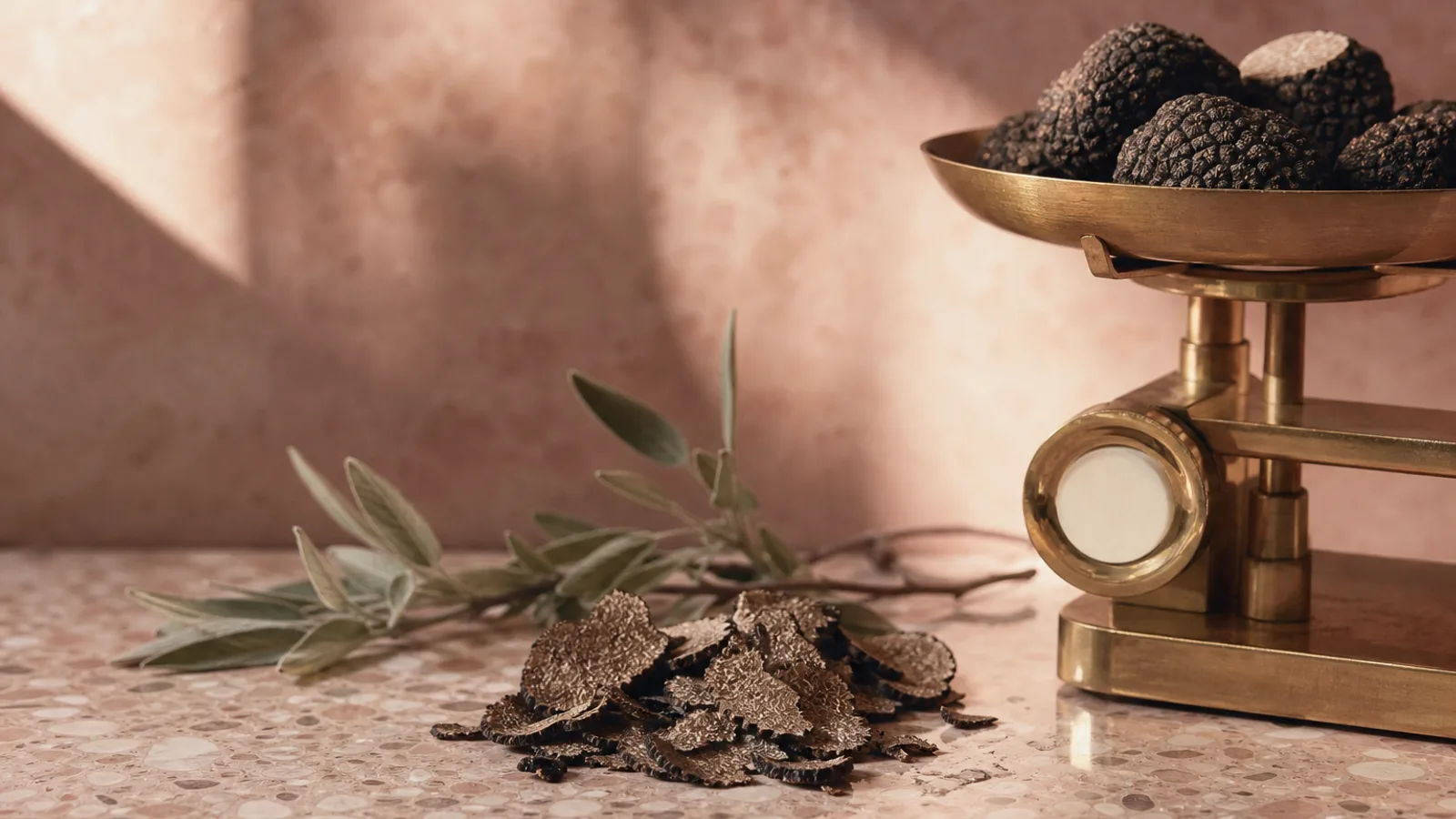
Truffles are subterranean fungi in the genus Tuber, and they have been prized as food for centuries. Their value in gastronomy comes from their rarity, their demanding growth conditions, and the extraordinary density of bioactive compounds they accumulate as they develop underground. The same properties that make them exceptional at the table make certain species, particularly Tuber melanosporum, the black Périgord truffle, compelling in high-performance skincare.
Black truffle extract used in skincare is derived from the fruiting body of Tuber melanosporum, processed to isolate or concentrate the relevant bioactive fractions. These include polysaccharides, amino acids, sterols, fatty acids, and a range of antioxidant compounds including phenolics and flavonoids. Each of these plays a distinct role in skin biology, particularly in the context of ageing skin where multiple mechanisms are declining simultaneously.
What most truffle skincare products on the market fail to account for is the delivery problem. Dropping a raw truffle extract into a serum base and applying it to the skin does not mean those compounds reach the dermis. The stratum corneum, the outermost layer of the skin, is a selective barrier. Molecules above approximately 500 Daltons in molecular weight are excluded. Most complex polysaccharides and intact peptides sit well above this threshold. They remain on the surface, providing some hydration and antioxidant effect to the top layers, but not reaching the tissue where collagen synthesis, elastin repair, and lipid matrix restoration actually occur.
This is the foundational problem with surface solutions, and it is why developing our bio-fermentation process was not optional. It was the only route to results that actually show up in the dermis.
Why Barossa Valley Truffles Specifically
Not all truffle extracts are equal, and sourcing matters more than most brands will admit. Truffelle grows its black truffles in the Barossa Valley, South Australia, on soil within a 35-million-year-old meteor crater. That detail is not marketing language. The impact event created a mineral profile in the soil that is genuinely rare, and the truffles that grow there accumulate a compound density that reflects their environment. They are hand-foraged at peak maturity, the point at which the concentration of bioactive compounds is at its highest, what I would describe as the peak molecular zenith of the truffle's development.
Comparison with industrially harvested truffle extracts from European or Asian suppliers used in mass-market skincare is difficult to draw precisely because those suppliers rarely disclose their sourcing or harvesting timing. What I can say with confidence is that a truffle harvested at full maturity from mineral-rich soil and processed within a defined time window is a fundamentally different raw material from one harvested for volume at variable stages of development.
The Key Bioactive Compounds in Black Truffle and What They Do for Skin
Polysaccharides: The Hydration and Barrier Architecture
Polysaccharides are complex carbohydrate molecules, and black truffle produces them in significant concentrations. In skin biology, polysaccharides serve two primary functions relevant to ageing skin.
First, they are hygroscopic, meaning they attract and bind water molecules. This is the mechanism behind truffle extract's hydration effect. Clinical data from Phenbiox and the University of Bologna measuring Tuber melanosporum extract on human subjects recorded a 48% increase in skin hydration over the trial period. This is not a surface moisturisation figure. The measurement accounts for hydration at multiple skin depths, which is only possible when the active reaches below the stratum corneum.
Second, polysaccharides support barrier repair. The skin's barrier function depends on the integrity of the lipid matrix in the stratum corneum, and polysaccharides from truffle extract contribute to the restoration of this architecture. In practical terms, this means reduced transepidermal water loss (TEWL), which is the passive evaporation of water through the skin that accelerates in ageing and menopausal skin as ceramide production declines.
For women in perimenopause and beyond, barrier competence is one of the most clinically significant skin concerns. Declining oestrogen reduces sebum production, disrupts the microbiome, and weakens the ceramide-rich lipid layer. A truffle polysaccharide fraction that restores this architecture from within the dermis addresses the actual cause rather than masking the symptom.
Amino Acids: The Collagen Precursor Supply Chain
Black truffle contains a broad spectrum of amino acids, including several that serve as direct precursors to collagen synthesis. Collagen is a triple-helix protein requiring specific amino acids, particularly glycine, proline, and hydroxyproline, in its assembly. Skin depleted of these precursors cannot repair and rebuild collagen efficiently regardless of other signals telling it to do so.
The collagen data associated with Truffelle's formulations is specific. Referencing the Journal of Modern Human Research 2023, collagen production increased by 30% in the trial cohort. The same 42-day trial, conducted with ultrasound imaging, recorded a 0.39mm increase in dermal thickness. That is a structural, measurable change in the composition of the skin, not a surface-effect metric.
Amino acid delivery to the dermis is subject to the same 500 Dalton gatekeeping as other compounds. Free-form amino acids from bio-fermentation, because they are reduced to their simplest molecular state during the fermentation process, pass this threshold without obstruction. This is distinct from applying collagen as a topical ingredient, which cannot penetrate the skin in its intact form regardless of how it is labelled on a product.
Antioxidants: Addressing Oxidative Ageing Directly
Oxidative stress is one of the primary drivers of skin ageing. Free radicals, generated by UV exposure, pollution, metabolic processes, and stress, damage collagen fibres, lipid membranes, and DNA in skin cells. The skin has its own antioxidant defence system, but this system weakens with age and is chronically overwhelmed in the urban, high-UV Australian environment.
Black truffle is rich in polyphenols, flavonoids, and other antioxidant compounds. Studies on Tuber melanosporum specifically have identified significant free-radical scavenging activity, meaning these compounds neutralise reactive oxygen species before they can damage skin structures. The phenolic content of black truffle extract also has documented anti-inflammatory properties, which matters because chronic low-grade inflammation, often called inflammageing, is now understood as a significant contributor to visible skin ageing.
For Australian women, the antioxidant case for truffle skincare has an added dimension. Australia has one of the highest UV irradiance levels in the world. The Australian Bureau of Statistics (ABS) consistently reports that Australia records extreme UV index levels across most of the continent for large portions of the year. An antioxidant-rich skincare active that can reach the dermis and neutralise oxidative damage at the tissue level is not a luxury consideration here. It is a functional one.
Sterols and Fatty Acids: Lipid Matrix Restoration
Truffle extract also contains ergosterol and various fatty acid compounds. Ergosterol is a precursor to vitamin D in fungi and has documented membrane-stabilising properties in mammalian cells. The fatty acids in truffle extract contribute to the skin's lipid matrix, supporting the ceramide-like architecture that maintains barrier integrity.
This lipid contribution is particularly relevant for the "Barrier Fortification" component of what I call the Master Key delivery system used across all Truffelle formulations. Where many barrier-focused skincare products add ceramides or fatty acids as topical occlusives that sit above the skin, a bio-fermented truffle fraction delivers these lipid-compatible compounds at the dermal level, supporting the skin's own production of structural lipids rather than temporarily substituting for them.
The Bio-Fermentation Process: Why It Changes Everything
Understanding why Truffelle's results differ from other truffle skincare products requires understanding the bio-fermentation process that produces the active ingredient. This is not a proprietary secret for its own sake. It is the mechanism that explains the clinical outcomes.
Phase 01: The Harvest. Truffles are hand-foraged from the Barossa Valley site at peak maturity. The timing of harvest is critical because bioactive compound concentration is not static across the truffle's development. Harvesting at the wrong stage means formulating with a fraction of the available potency.
Phase 02: The Fermentation. The truffles undergo a 90-day biological breakdown process. During this phase, the complex macromolecules present in the raw truffle, including large polysaccharides and intact proteins, are broken down by microbial enzymatic activity into smaller, bioavailable fragments. New bioactive metabolites are generated that do not exist in the raw truffle. The fermentation is not simply a method of extraction. It is a biochemical process that produces a qualitatively different set of compounds.
Phase 03: The Activation. At the completion of fermentation, the bio-concentrate reaches what we describe as maximum cellular compatibility. The resulting molecules are predominantly sub-500 Dalton in size, meaning they can cross the skin's molecular gateway to the dermis. The formulation is poured within 72 hours of fermentation completion to preserve batch-fresh potency. This is the detail that mass-market skincare cannot replicate at scale because it requires small, seasonal batches timed precisely to the fermentation cycle.
This three-phase process is what separates Truffelle from products that list "truffle extract" in their INCI name but use a standardised, shelf-stable extract processed for volume rather than bioavailability. Where other creams end, we begin, because the delivery mechanism is engineered from the raw material stage rather than added as an afterthought in the formulation.
Truffle Extract vs Retinol: An Honest Comparison
Retinol remains the most commonly recommended cosmetic anti-ageing active by dermatologists, and for documented reasons. It stimulates cell turnover, suppresses MMPs (the enzymes that break down collagen), and has decades of peer-reviewed literature supporting its use. I am not dismissing it.
But retinol carries trade-offs that are particularly significant for the audience most likely to need serious anti-ageing support, women in perimenopause and beyond, many of whom also have reactive or compromised skin barriers.
Retinol increases photosensitivity meaningfully, requiring consistent SPF use and often restricting application to night routines. During the initial period of use, a process sometimes called "retinisation," significant redness, peeling, and irritation are common. For women whose skin barrier is already compromised by hormonal changes, this initial period can be prolonged and distressing. Some synthetic retinoid formulations also contain compounds that are classified as potential endocrine disruptors, which is a meaningful concern for women in hormonal transition.
Bio-fermented truffle peptides carry none of these risk factors. There is no photosensitivity effect, no retinisation period, and no synthetic hormonal interference. The adaptogenic nature of the bioactive profile means the skin responds without the inflammatory stress response that retinol induces as part of its mechanism.
The comparison is not about which active is "better" in an absolute sense. It is about which active delivers structural results without adding complications to skin that is already navigating significant biological change. For the woman who knows the difference between a product that performs on a data sheet and one that performs on her face, that distinction matters.
Real Outcomes: What Truffelle Users Experience
Eleanor's Barrier Recovery
Eleanor M. had battled persistent facial redness for years. She had reactive skin that responded poorly to most actives, and she had tried formulations across multiple price points without resolution. She began using the Black Diamond Duo as her daily ritual. Within two weeks, the redness that had defined her skin for years began to subside. She described the experience as feeling like medicine for her skin barrier. That language resonates with me because it reflects the Barrier Fortification mechanism working as intended: not suppressing a symptom with anti-inflammatory agents, but restoring the structural architecture that prevents irritant penetration in the first place.
Victoria's Simplification
Victoria R. was running a six-step routine and still felt her fine lines and overall skin quality were not improving. On the recommendation to simplify, she replaced the entire routine with two Truffelle products. The outcome she described included softened fine lines around her eyes and a skin bounce she said she had not noticed since her twenties. This aligns directly with the clinical elasticity data: +35% improvement in skin elasticity measured over the trial period. Elasticity is what creates that quality of bounce. Hydration alone does not produce it.
Victoria's experience also illustrates the counter-intuitive reality of effective skincare: more steps do not compound results. They compound interference. The skin benefits from fewer, better-delivered actives clinically dosed and designed to reach where structural repair happens, not a layered stack of surface solutions that compete for absorption and dilute each other's effect.
Who Should Use Truffle Skincare?
The clinical profile of bio-fermented black truffle extract makes it particularly well-suited to several groups.
Women 40 and above. This is the period when collagen loss accelerates, oestrogen decline begins to affect skin barrier function, and the compounding effects of oxidative damage become visible. Truffle polysaccharides, amino acids, and antioxidants address all three simultaneously.
Menopausal and perimenopausal skin. Hormonal skin is reactive, barrier-compromised, and prone to dryness and inflammation. The tolerability profile of truffle-based actives, with no photosensitivity and no synthetic hormonal compounds, makes this an appropriate active for women who cannot tolerate conventional anti-ageing formulations.
Sensitive and reactive skin types. Eleanor's experience is representative of a broader pattern. Skin that has historically rejected actives responds differently to a formula engineered around barrier restoration rather than chemical stimulus.
Women seeking simplification. If you are managing a complex routine and not seeing results, the issue may not be that you need to add another product. It may be that you need a delivery system capable of doing the work that your current stack cannot.
Realistic Caveats
Transparency is non-negotiable here. The clinical data cited for truffle extract benefits, including the Phenbiox and University of Bologna figures and the Journal of Modern Human Research 2023 data, are real studies with specific measurements. However, skincare research exists on a spectrum. These are not large-scale randomised controlled trials published in tier-one medical journals. They are ingredient-level studies and controlled human trials of meaningful rigour, and they represent the current evidence base for truffle extract in skincare. As with any cosmetic active, individual results vary based on skin type, baseline condition, consistency of use, and the overall skincare environment.
Truffelle does not claim pharmaceutical outcomes. The outcomes described are cosmetic and are grounded in the best available evidence. Anyone with a diagnosed skin condition should consult a dermatologist before changing their routine.
How to Use Truffle Skincare: A Practical Protocol
The bio-fermented actives in Truffelle's formulations are designed to be applied to clean, slightly damp skin to support penetration. The product order follows a logic of molecular weight: lighter serums first, then cream.
Step 1: Apply The Serum to clean skin. The serum delivers the highest concentration of bio-fermented truffle bio-concentrate, optimised for dermal penetration.
Step 2: Follow with The Cream, which provides the lipid matrix support and occlusive layer to seal the active in and reduce transepidermal water loss.
For those beginning the protocol, the Black Diamond Duo combines both products and is the entry point most of our clients use. If you want to understand the full formulation rationale before purchasing, the science page covers the clinical evidence base in detail. To explore the full range, visit the collections page.
If you have specific skin concerns or want guidance on which products suit your profile, contact us directly. We do not operate on a one-size-fits-all consultation model.
Side Effects and Safety Profile
Black truffle extract has a well-documented tolerability profile. In the University of Bologna trials and in Truffelle's own client base, adverse reactions have been rare and mild. There are no known interactions with standard skincare actives.
The following points summarise the safety position:
- No photosensitivity: truffle actives can be used morning and night without SPF being required for the product's mechanism (though daily SPF remains best practice for any skincare routine in the Australian UV environment).
- No known endocrine disruption: the formulation contains no synthetic retinoids or parabens in classes associated with hormonal interference.
- Patch testing is still recommended for any new skincare product, particularly for those with documented contact allergies.
- Individuals with mushroom or mould allergies should consult a healthcare professional before use, as truffle is a fungal organism. Documented cases of skin reaction to truffle extract are rare in the cosmetic literature but theoretically possible for this population.
References
-
Phenbiox / University of Bologna truffle extract clinical trials - Peer-reviewed studies measuring the effect of Tuber melanosporum extract on skin hydration, elasticity, and wrinkle depth in human subjects over a 42-day period. Source of the +48% hydration, +35% elasticity, and 12.8% wrinkle depth reduction figures cited throughout this article.
-
Journal of Modern Human Research, 2023 - Published clinical trial measuring collagen production increase (+30%) and dermal thickness change (+0.39mm via ultrasound imaging) following topical application of fermented truffle bio-concentrate. Referenced for structural skin repair metrics.
-
Australian Bureau of Statistics (ABS) UV Irradiance Data - ABS-published environmental health data documenting Australia's UV index levels across the continent, supporting the case for antioxidant-focused skincare in the Australian market context. Available via the ABS official website.
-
Australian Competition and Consumer Commission (ACCC) Cosmetic Claims Guidelines - ACCC guidance on substantiation requirements for cosmetic efficacy claims in Australia, relevant to how truffle skincare outcomes should be communicated responsibly to consumers.
-
Mello, A. et al. (2021). Phytochemical Profile and Bioactive Properties of Tuber melanosporum. - Academic review of the phenolic compounds, polysaccharides, sterols, and amino acids present in black truffle fruiting bodies, providing the foundational chemistry referenced in the bioactive compounds section of this article.
-
Elias, P.M. (2005). Stratum Corneum Defensive Functions: An Integrated View. Journal of Investigative Dermatology. - Seminal reference establishing the 500 Dalton molecular weight threshold for dermal penetration of topical compounds, underpinning the delivery rationale for bio-fermented skincare actives.


