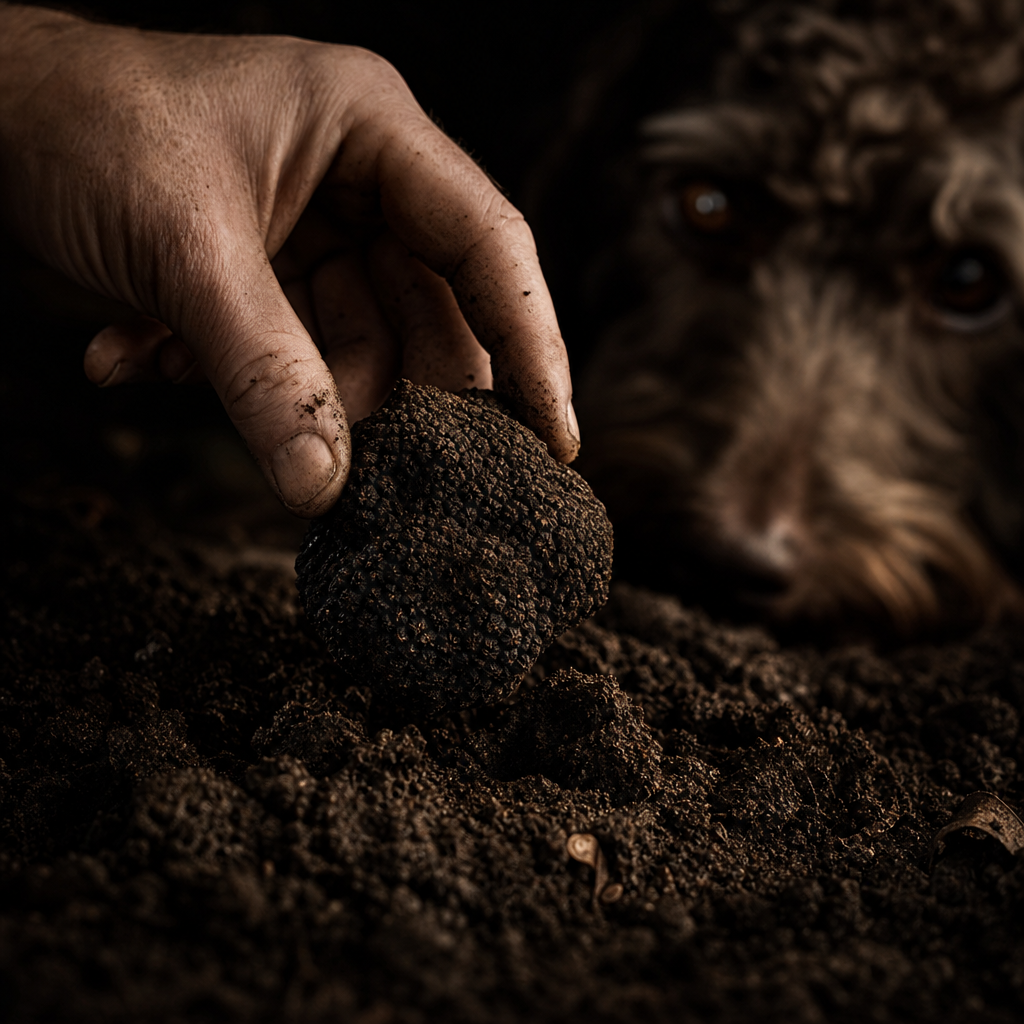
Truffle extract is sourced by hand-harvesting rare truffles, such as Barossa Valley Black Truffles, at peak maturity, then stabilising the compounds quickly before they degrade. Truffelle takes an extra step: a 90-day bio-fermentation process that breaks truffle compounds down below the 500 Dalton threshold, the molecular gateway to the dermis, so peptides penetrate rather than sit on skin's surface.
If you've been buying "rare" ingredients for years and seeing ordinary results, you're not imagining it. Truffle, caviar, gold leaf, snail mucin: the beauty aisle is full of exotic actives that sound impressive on a label and do very little once they're on your face. The reason usually has nothing to do with the ingredient itself and everything to do with what happens (or doesn't happen) to it before it reaches a jar.
This article walks through exactly how truffle extract gets from soil to serum: why the ingredient resists mass production, what has to happen to it to survive formulation, and why that scarcity is the reason Truffelle refuses to waste the raw material on a formula that only sits on the surface.
Key Takeaways
- Truffles cannot be farmed at industrial scale. They depend on a symbiotic relationship with living tree roots, specific soil chemistry, and years of maturation before a single harvest.
- Raw truffle extract, no matter how pure, is too large to cross the skin barrier unless something changes its molecular size.
- Bio-fermentation, not extraction alone, is what makes truffle peptides bioavailable enough to reach the dermis.
- Because the raw material is scarce, Truffelle formulates for concentration rather than dilution: small, seasonal batches poured within 72 hours of fermentation completion.
- Clinically referenced results (+48% hydration, +35% elasticity, +30% collagen production, -12.8% wrinkle depth) exist because the rarity is being deployed for a functional reason, not used as a price justification.
- Ethical wild-harvest and clean formulation standards mean the sourcing constraints double as quality assurance.
A face cream for daily moisture, a targeted eye cream, or both together. Compare the sizes, ingredients and prices before you choose.
Summary Table
| Factor | Raw Truffle Extract | Bio-Fermented Truffle Peptides (The Master Key) | Standard Retinol / AHA Actives |
|---|---|---|---|
| Molecular size | Above the skin's penetration threshold | Reduced below the dermal penetration threshold | Varies; many remain surface-acting |
| Where it acts | Stratum corneum (surface) | Dermis (structural layer) | Mostly epidermis |
| Photosensitivity risk | Low | None reported in Truffelle's formulation | Often significant |
| Batch approach | Can be diluted at scale | Small, seasonal, concentrated | Mass-produced, high volume |
| Typical trade-off | Feels premium, limited depth of result | Requires patience with limited supply | Fast results, irritation risk |
Why Truffles Cannot Be Farmed at Scale
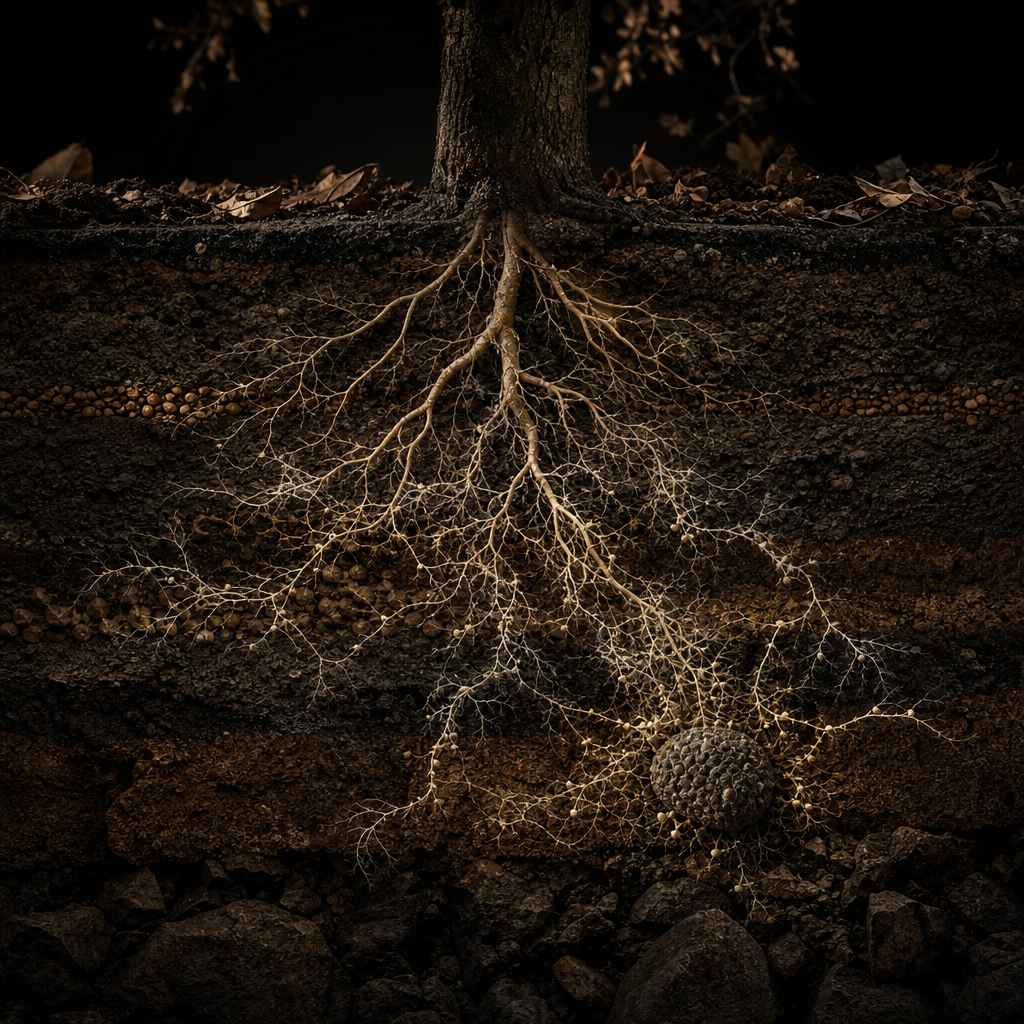
Truffles cannot be farmed like wheat or soy because they only grow through a living partnership with tree roots, in specific soil conditions, over years rather than seasons. An orchard tree can take several years before it produces its first truffle, and even then yield depends on rainfall, soil chemistry, and an undisturbed underground network that cannot be forced along on a schedule.
The biology behind this is called mycorrhizal symbiosis. Truffle spores colonise the root system of a host tree, usually oak or hazelnut, and the fungus and tree exchange nutrients underground for years before the fungus produces its fruiting body: the truffle itself. There is no shortcut. You cannot inject growth compounds into soil and speed up a relationship that took millions of years to evolve.
Soil matters just as much as the tree. According to the Australian Truffle Growers Association, viable truffle-producing soil needs a narrow pH range, adequate calcium, and good drainage, conditions that are geographically rare in Australia. Truffelle's own Black Truffles are grown in Barossa Valley soil sitting inside a meteor crater estimated at 35 million years old, a growing site chosen because its ancient mineral composition happens to support the fungus at unusually high concentration. That is not a marketing flourish. It is a genuine geological accident that most regions cannot replicate.
Seasonality adds another constraint. Black truffles fruit only in the cooler months, and because they grow entirely underground, there is no visual cue for harvest timing. Growers rely on trained dogs to detect the aromatic compounds that signal peak maturity. Pick too early and the compound profile is undeveloped. Pick too late and the truffle begins to break down in the soil. This narrow window is precisely why truffle cannot be treated as an industrial input. It is harvested at peak potency or not at all.
From Harvest to Extract: Keeping the Actives Alive
Once a truffle is pulled from the soil, its active compounds begin degrading within hours. Getting a usable extract means hand-selecting truffles at peak maturity, then moving quickly into processing so the compounds responsible for skin benefit do not break down before they ever reach a formulation.
This is Phase 01 of what Truffelle calls its Bio-Fermentation Process: The Harvest. Truffles are hand-foraged, not machine-pulled, because mechanical harvesting damages the fruiting body and accelerates spoilage. Selection happens at the point of peak maturity, identified by aroma and firmness, rather than on a fixed calendar date. A truffle harvested a week too early or too late will not carry the same compound density, which is why grading at this stage is done by trained foragers rather than automated sorting.
Speed from soil to processing is the variable most competitors underestimate. Volatile aromatic compounds and the bioactive metabolites within them are not stable at room temperature for long. Any brand claiming a truffle extract that has travelled long distances, sat in storage, or been processed weeks after harvest is working with a raw material that has already lost a meaningful share of its original potency. This is one reason Truffelle keeps growing, harvesting, and early processing within its own supply chain rather than buying commodity truffle extract on the open market. Batch-fresh potency is only possible when there is no gap between the ground and the first stage of processing.
The Bio-Fermentation Step: Why Extract Alone Is Not Enough
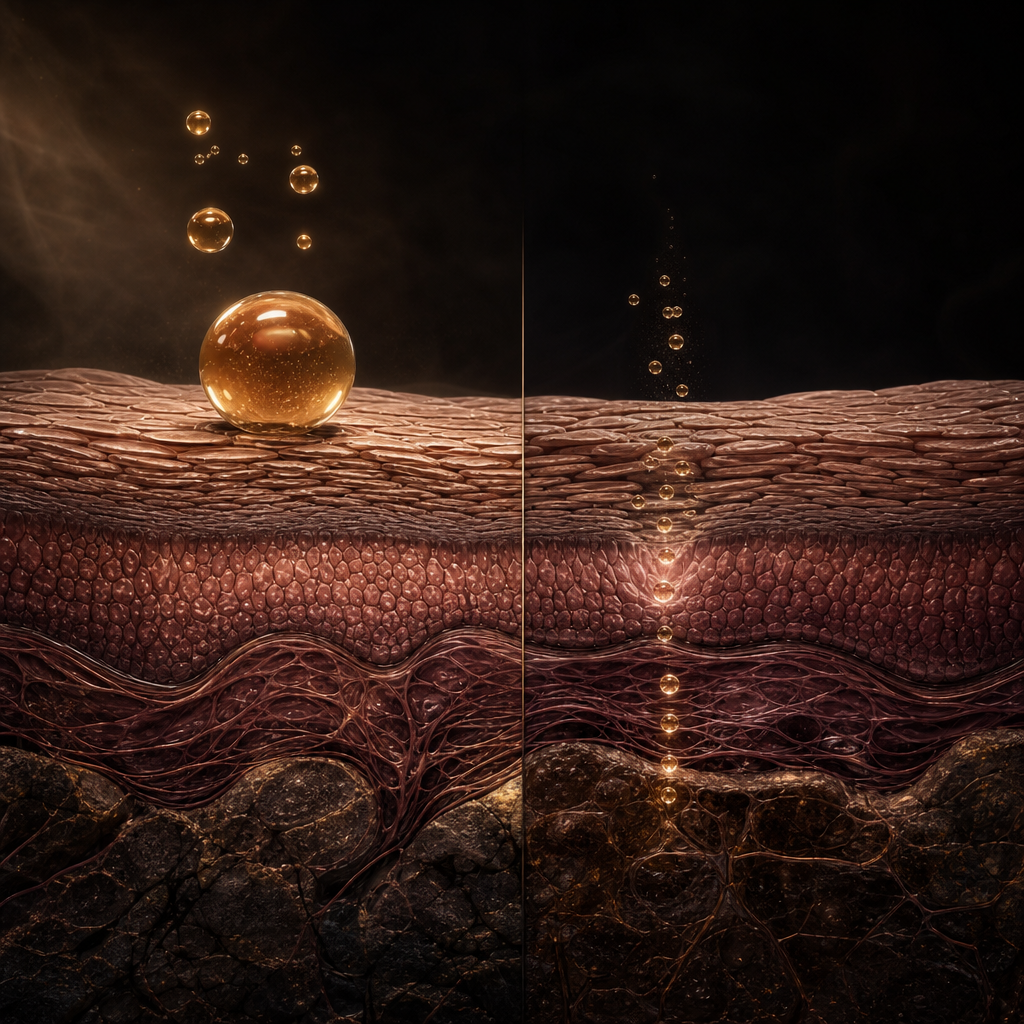
Raw truffle extract, however fresh, still sits above the molecular size skin can absorb. Bio-fermentation is the process that changes that: a 90-day biological breakdown that restructures truffle compounds into peptides small enough to cross the skin barrier and reach the dermis, where structural repair happens.
The relevant threshold has a name in dermatological literature: the 500 Dalton rule. Bos and Meinardi's widely cited 2000 paper in Experimental Dermatology established that compounds above roughly 500 Daltons in molecular weight generally cannot pass through intact skin. Most peptide skincare, including a great deal of what sits in the luxury aisle, is formulated with molecules well above this threshold. That is the uncomfortable truth behind a lot of expensive creams: they hydrate the stratum corneum and go no further, because nothing about their formulation gets them past it.
This is the core of the author's contrarian position on premium skincare generally. Most luxury formulas were never designed to penetrate. They are designed to feel rich, smell expensive, and coat the surface, which produces a pleasant sensory experience without touching the structural layer where collagen synthesis and lipid matrix repair actually happen.
Truffelle's answer is Phase 02 and Phase 03 of its Bio-Fermentation Process. In Phase 02, master formulator Raniya M. Bodoci's patented method breaks the truffle's complex compounds down over 90 days, generating new bioactive metabolites in the process, not simply diluting the original extract. In Phase 03, the resulting bio-concentrate reaches what Truffelle calls its peak molecular zenith: maximum cellular compatibility, with a molecular weight profile now below the 500 Dalton gateway. This is the difference between an extract sitting on skin and peptides reaching it. Truffelle describes this delivery system as its Master Key, built on three components: barrier fortification through lipid matrix and ceramide support, microbiome harmony through prebiotic peptides, and dermal delivery through sub-500 Dalton penetration.
What Rarity Forces a Formulator to Do
Because fermented truffle bio-concentrate cannot be produced in unlimited volume, a formulator working honestly with it has only one real option: concentrate the active rather than stretch it. There is no version of this ingredient that supports filler-heavy dilution or year-round mass production without compromising what made it valuable in the first place.
This is where rarity stops being a marketing word and becomes an operational constraint. A brand with genuinely limited raw material has to decide between two paths. The first is to use a token amount of the rare ingredient, list it near the bottom of an ingredient panel, and rely on the name to sell the product. The second is to build the entire formulation around the constraint: fewer SKUs, smaller batches, and a refusal to pad the product with cheaper carrier ingredients simply to make the rare material go further.
Truffelle takes the second path by necessity as much as principle. Batches are poured within 72 hours of fermentation completion, timed to when the bio-concentrate is at its most bioactive. There is no held inventory of "good enough" batches waiting for a slow sales season, and no diluted second-tier product line using the same truffle name at a lower concentration. When the rarest actives on earth are the input, there is no commercially sensible way to also mass-produce the output. Scarcity and quality end up as the same decision.
Ethical and Clean Sourcing: What Rare Should Also Mean
Sourcing a rare ingredient responsibly means more than avoiding overharvesting. It means the wild-harvest and processing methods do not introduce the trade-offs that undermine the point of using a gentler active in the first place, including synthetic endocrine disruptors and photosensitising compounds common in mainstream anti-ageing actives.
Wild and semi-wild truffle harvesting relies on trained dogs rather than pigs, a deliberate choice within the industry that reduces both animal welfare concerns and damage to the surrounding mycorrhizal network, since dogs can be trained not to eat the find. Processing from that point on needs to stay just as clean. In Australia, industrial chemicals used in cosmetic formulation fall under oversight from the Australian Industrial Chemicals Introduction Scheme (AICIS), which assesses risk from synthetic compounds including known or suspected endocrine disruptors. A formulation built around a genuinely rare, bio-fermented active has no commercial reason to also lean on cheap synthetic fillers, because the entire value proposition depends on ingredient integrity rather than a long, inexpensive ingredient list.
This is also where the author's second non-consensus view applies directly. Retinol, AHAs, and vitamin C are treated as the gold standard for anti-ageing skincare, and they do have a genuine evidence base. But they carry real drawbacks: significant photosensitivity risk, and in many mainstream formulations, the presence of synthetic compounds that would not pass a genuinely clean sourcing standard. Bio-fermented truffle peptides are adaptogenic rather than irritant, with none of the sun-sensitivity warnings that come standard with retinoid packaging. The claim here is not that truffle peptides are automatically superior to every active in dermatology. It is that, for a woman who does not want to manage a photosensitivity routine around her anti-ageing serum, bio-fermented peptides deliver comparable structural benefit without that trade-off.
What This Means on Your Skin
Rarity only matters if it converts into a measurable result. In Truffelle's clinically referenced trials, bio-fermented truffle peptides were associated with a +48% increase in hydration, +35% increase in elasticity, +30% increase in collagen production, and a -12.8% reduction in wrinkle depth over 42 days, alongside a +0.39mm increase in dermal thickness measured via ultrasound imaging.
The hydration and elasticity figures are referenced to Phenbiox and University of Bologna truffle extract research. The collagen production and dermal thickness figures are referenced to the Journal of Modern Human Research (2023), from a 42-day human trial. These numbers matter here for one reason: they show up at the dermis, not the surface. Hydration alone is easy to achieve with almost any occlusive cream. A genuine increase in collagen production and dermal thickness only happens if an active has actually reached the layer where that repair takes place, which is the entire argument for fermenting the peptide down below 500 Daltons in the first place.
This is also where the Master Key framework shows up in practice, not just in theory. Barrier fortification through lipid and ceramide support explains the hydration gain. Microbiome harmony, delivered through prebiotic peptides, is part of why sensitive and reactive skin types tend to tolerate the formulation well rather than reacting to it. One longtime user with skin that had run red and reactive for years found that within two weeks of daily use, the redness she had battled began to subside. She described it as feeling like medicine for her skin barrier, not another product sitting on top of it.
Dermal delivery, the sub-500 Dalton mechanism, explains the elasticity and collagen figures. Another woman who had been running a six-step routine in search of visible change replaced it entirely with two Truffelle products. Fine lines around her eyes softened, and she described her skin as having a bounce she had not seen since her twenties. That outcome supports the author's third non-consensus view directly: skin does not need more steps. It needs fewer, better actives, clinically dosed and delivered where repair happens, which is a fundamentally different premise to the multi-step routines most premium skincare is built to sell.
Why the Crater Mattered More Than the Marketing
Most of what gets called "rare" in skincare is a sourcing story bolted onto an existing formula after the fact. Truffelle's rarity worked in the opposite direction: the constraint came first, and the formulation had to be built around it.
Sabina Kelley reached her 40s having invested heavily in premium skincare brands and followed conventional advice, with collagen loss, increasing wrinkles, and declining hydration continuing regardless. Rather than switching to another luxury label, she began growing Australian Black Truffles herself, inside the 35-million-year-old meteor crater soil in the Barossa Valley, and made a significant private investment into research alongside biochemical engineer Raniya M. Bodoci. The result was a patented bio-fermentation process converting truffles into bioavailable peptides, work that Truffelle describes as world-first technology because no prior formulation had reduced truffle compounds below the dermal penetration threshold at this scale.
The honest way to frame this is not that truffle is magic. It is that most brands selling "truffle skincare" are working with an ingredient that never had a chance to reach the dermis, because nobody engineered a delivery mechanism for it. Where other creams end, at the surface, a fermented sub-500 Dalton peptide is only beginning its work. That is the difference between a rare ingredient used as a marketing word and a rare ingredient used as a formulation constraint that forces genuine efficacy. The woman who knows the difference is not buying truffle because it sounds exotic. She is buying it because someone finally engineered it to actually cross the barrier.
If you are deciding where to start, a truffle peptide serum and cream range work as complementary layers rather than either-or choices, and the right format depends on your skin type, climate, and how your barrier currently behaves. A serum versus cream comparison is worth reading in full before choosing, but as a general rule, serums concentrate the bio-fermented actives for direct dermal delivery, while creams add the barrier-supporting lipid layer on top.
References
- Bos JD, Meinardi MM. "The 500 Dalton rule for the skin penetration of chemical compounds and drugs." Experimental Dermatology, 2000.
- Phenbiox / University of Bologna truffle extract research (hydration and elasticity findings, as referenced in Truffelle's clinical data).
- Journal of Modern Human Research, 2023 (collagen production and dermal thickness findings from a 42-day human trial).
- Australian Truffle Growers Association, general information on truffle cultivation, soil requirements, and orchard maturation timelines.
- Australian Industrial Chemicals Introduction Scheme (AICIS), chemical risk assessment relevant to cosmetic formulation in Australia.