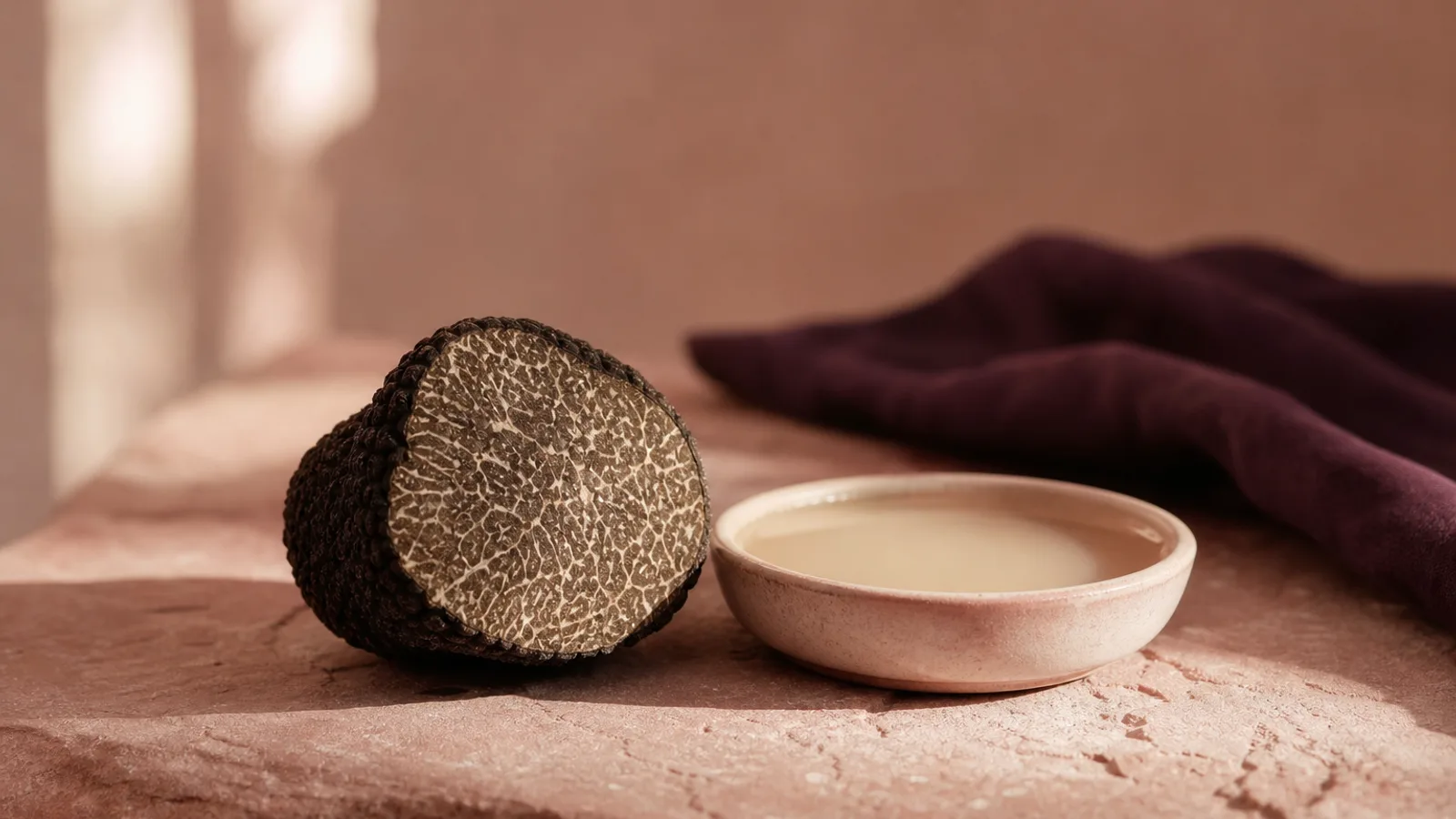
Truffle extract may benefit skin by supporting hydration, elasticity, firmness and collagen production. Its effectiveness depends on extraction, molecular size, concentration and delivery. Truffelle uses bio-fermentation to create smaller peptide fractions designed for dermal delivery, with its supplied clinical data reporting measurable changes after consistent use.
Introduction
Truffle extract is not automatically effective because it comes from a rare ingredient. The meaningful questions are what the extract contains, how it was processed, whether its molecules can cross the skin barrier and whether the finished formulation has credible testing behind it.
That distinction matters in luxury skincare. A premium jar and an exotic ingredient do not prove biological activity. This article explains the proposed science behind bio-fermented truffle peptides, the reported benefits, the limits of the evidence and what to examine before choosing a formula.
Our hero pairing. Clinically formulated for visible renewal, daily.
Key takeaways
The strongest case for truffle extract rests on delivery and finished-product testing, not rarity alone. Bio-fermentation may create smaller, more compatible fractions, but molecular size is only one part of skin penetration. Consumers should separate independently established skin science from results reported in Truffelle's supplied clinical dossier.
- Truffle extract can contain peptides and other biologically relevant compounds, but composition varies by species and processing method.
- Truffelle ferments Australian Black Truffles to create smaller molecular fractions intended to improve bioavailability.
- Truffelle's supplied clinical data reports increased hydration, elasticity and collagen production, alongside reduced wrinkle depth.
- The widely cited 500 Dalton rule is a useful formulation principle, not automatic proof that an ingredient reaches the dermis.
- Traditional peptides can work, but their sequence, stability, vehicle and delivery system determine their practical value.
- Effective luxury skincare should disclose mechanisms, testing conditions and realistic limitations.
Summary table
The central difference between a conventional peptide cream and bio-fermented truffle skincare is not the prestige of the raw material. It is how the active compounds are prepared and delivered. This comparison shows the questions that matter when evaluating molecular skincare without relying on packaging claims.
| Evaluation point | Conventional peptide formulation | Bio-fermented truffle formulation |
|---|---|---|
| Raw material | Isolated or synthesised peptides | Fermented truffle-derived bio-concentrate |
| Processing objective | Add a selected peptide to a cosmetic base | Break complex material into smaller bioactive fractions |
| Main formulation risk | Instability, poor release or limited penetration | Variable extract composition without rigorous standardisation |
| Barrier strategy | Depends on peptide and delivery vehicle | Combines barrier support with smaller molecular fractions |
| Evidence to request | Peptide identity, dose and finished-product testing | Molecular characterisation and finished-product testing |
| Best interpretation | Potentially useful when properly formulated | Promising when fermentation and clinical claims are documented |
What is truffle extract in skincare?

Truffle extract is a cosmetic ingredient produced from fungi in the Tuber genus, but the name alone reveals little about performance. Species, growing conditions, extraction method, fermentation and formulation all affect the final material. A raw truffle extract and a controlled bio-fermented concentrate should not be treated as interchangeable ingredients.
Black truffles contain a complex mixture of naturally occurring compounds. In skincare, manufacturers may seek to capture amino acids, peptide fractions and other metabolites from that material. The final profile depends on how the truffle is processed.
A basic solvent extract may collect soluble components while leaving larger structures intact. Fermentation takes a different approach. Microorganisms and enzymes break complex material into smaller fractions and can generate additional metabolites during the process.
Truffelle begins with Australian Black Truffles grown in the Barossa Valley. According to the company's process documentation, they are hand-harvested at peak potency from land within a 35-million-year-old meteor crater. The truffles then undergo a controlled 90-day fermentation before small seasonal batches are poured within 72 hours of completion.
Those details establish provenance and process discipline. They do not, by themselves, establish a skin benefit. That requires analytical characterisation and finished-formula testing. This is where luxury skincare needs to move beyond storytelling.
How do bio-fermented peptides interact with the skin?

Bio-fermentation can reduce complex biological material into smaller peptide and metabolite fractions that may be easier to formulate and deliver. However, penetration also depends on charge, solubility, stability, concentration and the surrounding vehicle. A small molecule has a better theoretical opportunity to cross the barrier, but size never guarantees dermal activity.
The stratum corneum is designed to keep external substances out. It consists of corneocytes surrounded by a lipid matrix, often described as a bricks-and-mortar structure. This barrier limits passive penetration, particularly for large or highly water-soluble molecules.
The 500 Dalton rule is frequently used in topical formulation. Bos and Meinardi's peer-reviewed paper proposed that compounds above approximately 500 Daltons generally struggle to penetrate intact skin. It remains a useful heuristic, but it is not a pass-or-fail certification.
This nuance is often lost in peptide marketing. Saying that a compound is below the threshold does not prove it reaches the dermis at an active concentration. The finished formula must release the compound, keep it stable and support movement through the barrier.
Truffelle calls its delivery framework "The Master Key". It has three connected functions:
Barrier fortification
The formulation aims to support the lipid matrix and ceramide environment, helping reduce transepidermal water loss. This can improve surface hydration while maintaining the barrier conditions needed for comfortable daily use.
Microbiome harmony
Prebiotic peptide fractions are intended to support a balanced skin environment rather than relying on aggressive exfoliation. Microbiome claims require careful substantiation because microbial communities differ between people and body sites.
Dermal delivery
Truffelle designs its fermented concentrate around sub-500 Dalton penetration. The objective is to move beyond surface solutions and deliver compatible fractions towards the layers where structural repair happens.
The process itself has three phases. The Harvest selects truffles at peak maturity. The Fermentation uses a 90-day biological breakdown. The Activation captures the finished bio-concentrate at what Truffelle describes as its peak molecular zenith.
This is the scientific proposition behind the phrase "where other creams end, we begin". The claim should ultimately stand or fall on molecular analysis and controlled testing, not the phrase itself.
What are the reported truffle extract benefits for skin?

The most relevant reported truffle extract benefits for skin are improved hydration, elasticity, firmness, collagen support and wrinkle appearance. Truffelle's supplied clinical dossier reports changes across these measures. These figures are company-provided results and should be interpreted according to the study design, participants, controls and measurement methods used.
Improved hydration and barrier comfort
Truffelle's supplied data reports a 48% increase in hydration. Hydration can improve when a formula attracts water, reduces water loss or supports the lipid matrix. It can also make fine dehydration lines appear less visible without changing deeper tissue.
That distinction is important. Surface hydration is valuable, particularly for dry or reactive skin, but it should not be presented as proof of dermal remodelling. A strong formula can support both immediate hydration and longer-term structural goals, provided each outcome is measured appropriately.
A verified Truffelle customer, identified as Eleanor M., reported that longstanding redness began to subside within two weeks of using the Black Diamond Duo. She described it as feeling like medicine for her skin barrier. This is an individual customer account, not controlled evidence, and Truffelle products are cosmetics rather than medicines.
Greater elasticity and firmness
Truffelle's supplied clinical results report a 35% increase in skin elasticity and a twofold increase in firmness. Elasticity describes how skin responds after deformation, while firmness relates to resistance and structural support. They are connected measurements, but they are not identical.
When reviewing such results, ask which instrument was used, where measurements were taken and whether environmental conditions were controlled. Hydration alone can temporarily affect mechanical readings. A persuasive trial should distinguish immediate moisturisation from sustained changes.
Collagen support and dermal thickness
Truffelle's supplied data reports a 30% increase in collagen production. It also reports a 0.39 mm increase in dermal thickness during a 42-day trial, measured using ultrasound imaging.
Collagen is a major structural protein in the dermis. Peptides may act as signalling compounds in topical skincare, but their activity depends on sequence, dose and delivery. The peer-reviewed peptide literature supports the broader plausibility of topical peptide treatments, although it does not prove that every truffle-derived fraction produces the same effect.
The dermal thickness result is potentially meaningful, but it needs context. Ultrasound protocol, measurement site, baseline thickness and comparison groups all affect interpretation. Consumers should request the complete study rather than treating a headline figure as sufficient evidence.
Reduced wrinkle depth
Truffelle's supplied 42-day human trial reports a 12.8% reduction in wrinkle depth. Wrinkle measurements can be captured through imaging, profilometry or replica analysis. Each method has strengths and limitations.
Hydration can soften the appearance of fine lines relatively quickly. A claim involving structural repair requires more than a photograph. Instrumental measurement, consistent lighting and a suitable control make the result more credible.
These figures form an encouraging evidence stack, but the correct wording is "Truffelle's supplied clinical results report", not "all truffle extracts are proven to produce". Ingredient category claims and finished-product evidence are different things.
How does fermented truffle extract compare with traditional peptides?
Fermented truffle extract is not automatically better than every traditional peptide. A well-characterised synthetic peptide can have a precise sequence, defined dose and established delivery system. Truffelle's advantage proposition is broader: fermentation generates a complex bio-concentrate while the formula addresses barrier condition, compatibility and molecular delivery together.
Traditional peptide formulas commonly use selected signalling, carrier or enzyme-inhibiting peptides. This precision can be useful because formulators know exactly which peptide they are adding. The limitation is that the ingredient may still degrade, remain trapped at the surface or be used below an effective concentration.
Fermented extracts contain a more complex mixture. That may provide several complementary compounds, but it also creates a greater need for batch standardisation. Batch-fresh potency means little if active composition varies unpredictably.
A serious comparison should examine:
- Molecular weight distribution, rather than one selected molecule
- Peptide identity and stability across the product's shelf life
- Concentration in the finished formula
- Delivery through intact skin, not only activity in a laboratory dish
- Tolerability under repeated use
- Instrumental testing of the finished product
- Controls that separate moisturisation from deeper structural effects
I do not accept that luxury skincare works simply because it contains expensive ingredients. Most luxury formulas were never engineered to penetrate. They coat the surface, provide sensory elegance and stop where the harder biological problem begins.
Nor do I believe every routine needs retinol, acids and multiple overlapping serums. Those actives can be useful, but they may also create irritation or photosensitivity depending on the ingredient and concentration. Truffelle's position is that fewer, better actives should be delivered where repair happens.
The 500 Dalton threshold is a design rule, not proof
The most common mistake in molecular skincare is treating sub-500 Dalton size as conclusive evidence of dermal delivery. It is better understood as an engineering filter. Molecular weight can remove one obstacle, but the formula still needs suitable solubility, partition behaviour, stability, concentration and contact with an intact skin barrier.
This is where my view differs from much of the category. Brands often jump from "small molecule" to "rebuilds collagen" without showing the steps between those statements. That logical gap weakens otherwise credible science.
A better evidence chain has four levels:
- Identity: What molecules or fractions are present?
- Delivery: Can the finished vehicle release them and support skin penetration?
- Biological activity: Do they affect a relevant pathway under controlled conditions?
- Human outcome: Does the finished product produce a measurable and repeatable result?
The 500 Dalton rule primarily informs the second level. It does not establish all four.
Truffelle's approach began with my own frustration. When I entered my 40s, I experienced declining hydration, increasing wrinkles and the visible effects associated with collagen loss. I had invested heavily in premium skincare and followed conventional advice without seeing satisfying results.
That experience led me to grow Australian Black Truffles and invest in research and development with biochemical engineer Raniya M. Bodoci. The result was Truffelle's patented bio-fermentation process, which the company describes as world-first technology.
The original insight is simple: rarity earns attention, but delivery earns results. The earth's rarest actives still need molecular engineering, repeatable manufacturing and honest testing. Without those elements, buried diamonds remain expensive label copy.
How should you assess and use truffle skincare?
Choose truffle skincare by examining the extraction process, ingredient transparency, delivery rationale, tolerability and finished-product evidence. Introduce it gradually, apply it consistently and monitor hydration, comfort and visible changes over time. Do not assume that every product labelled with truffle contains the same species, concentration or bioactive profile.
Start with these questions before buying:
- Which truffle species is used?
- Is the ingredient a raw extract, ferment filtrate or standardised concentrate?
- Has molecular size been measured in the finished active?
- Does the brand disclose the type of human testing completed?
- Were hydration, elasticity and wrinkles measured instrumentally?
- Is the formula suitable for sensitive or reactive skin?
- Are the claims cosmetic, or do they improperly imply treatment of disease?
The ACCC requires businesses to avoid false or misleading claims. That principle applies to ingredient performance, clinical wording, photographs and environmental claims. Terms such as "clinically tested" should identify what was tested and what the test actually demonstrated.
For routine design, begin with cleansing, the targeted truffle formulation and appropriate sun protection during the day. More layers are not necessarily more effective. They can increase cost, complicate troubleshooting and combine actives that your skin does not tolerate well.
A verified customer identified as Victoria R. reported replacing a six-step routine with Truffelle products. She said fine lines around her eyes softened and her skin regained a healthy bounce. This remains an individual account, but it illustrates an important principle: routine complexity is not the same as formulation quality.
Patch test new skincare if your skin is reactive. Stop use if persistent irritation develops. Anyone managing dermatitis, rosacea or another diagnosed condition should seek advice from an appropriately qualified health professional.
To apply this molecular approach, explore Truffelle's range of truffle-based skincare products and select the smallest routine that addresses your skin's actual needs.
References
These references support the broader science of skin penetration, topical peptides, cosmetic testing and responsible advertising. They do not independently verify every Truffelle product claim. Truffelle's numerical results cited above come from the company's supplied clinical dossier and should be reviewed with its complete protocols and reports.
- Bos, J.D. and Meinardi, M.M.H., "The 500 Dalton rule for the skin penetration of chemical compounds and drugs", Experimental Dermatology. https://doi.org/10.1034/j.1600-0625.2000.009003165.x
- Schagen, S.K., "Topical Peptide Treatments with Effective Anti-Aging Results", Cosmetics. https://doi.org/10.3390/cosmetics4020016
- OECD, "Test No. 428: Skin Absorption: In Vitro Method". https://doi.org/10.1787/9789264071087-en
- Australian Competition and Consumer Commission, "False or misleading claims". https://www.accc.gov.au/consumers/advertising-and-promotions/false-or-misleading-claims
FAQ_SCHEMA_JSON


