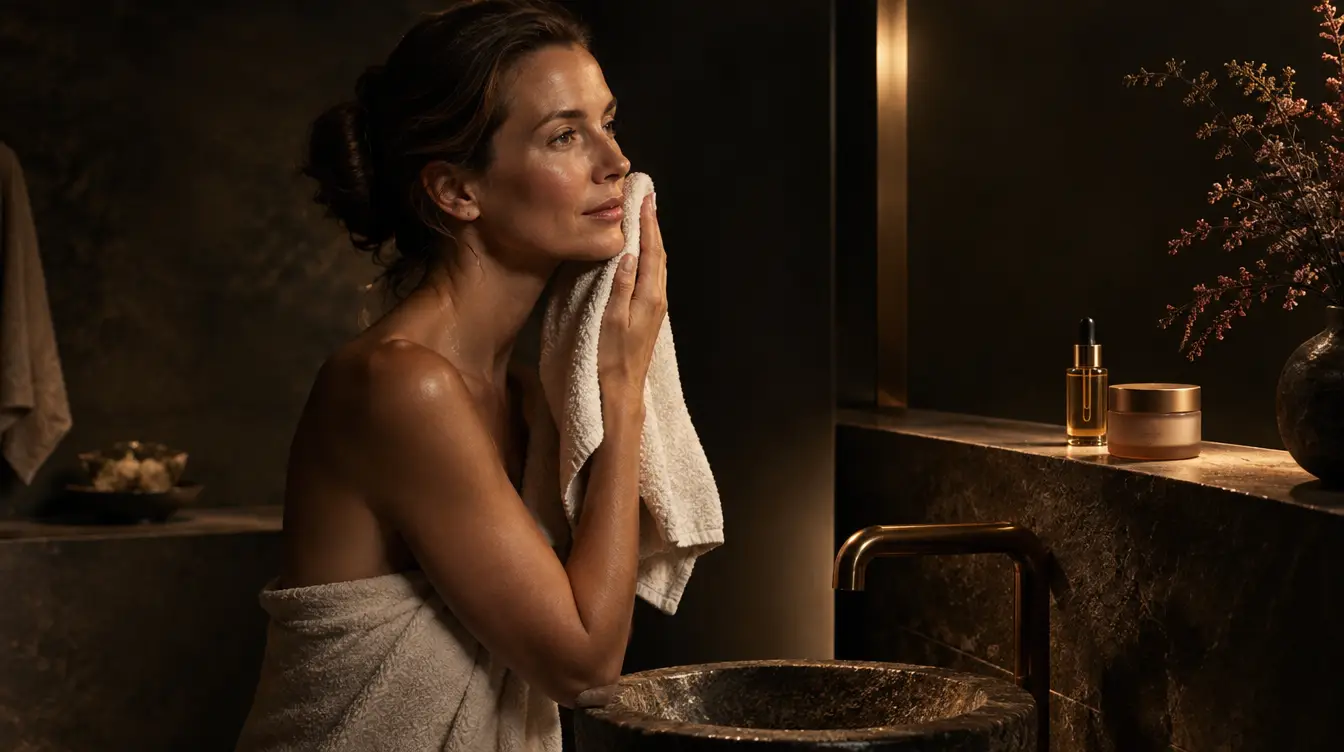
Perimenopause breakouts are usually linked to shifting hormones, which can also leave skin drier and less comfortable at the same time. For dry, breaking-out skin, a short routine usually suits best: a gentle cleanse, a comfortable moisturiser, daily sunscreen, and one new product at a time. Persistent, painful or cystic breakouts need a GP or dermatologist.
When Truff'elle founder Sabina Kelley reached her forties, her skin changed. It felt drier and less comfortable, and the routine and luxury products she had relied on for years no longer felt right. Plenty of women tell us the same story, and many add a surprise on top: breakouts they thought they had left behind in their twenties.
This article is about cosmetic care for comfort, look and feel. It is not a treatment for acne or any skin condition. You will find out why hormonal breakouts in your 40s can show up alongside dryness, why the usual breakout advice often makes things worse, and how a simple routine, built one change at a time, can help your skin feel calmer. We also cover when it is time to talk to a professional.
Key Takeaways
- Breakouts and dryness can happen together in perimenopause because hormones, oil production and the skin barrier are all shifting at once.
- Most breakout advice is written for oily, teenage skin. Stripping cleansers and stacked actives tend to backfire on dry, reactive skin.
- A simple routine has four parts: cleanse gently, moisturise face and neck, add eye care only if you want it, and protect daily with sunscreen.
- Patch test, add one product at a time, and give it several weeks before you judge it or add another.
- The Truff'elle Eye Cream contains retinol. Use it only around the eyes as directed, introduce it gradually, and never use it as a spot treatment.
- Painful, deep, cystic or persistent breakouts warrant advice from your GP or a dermatologist.
A face cream for daily moisture, a targeted eye cream, or both together. Compare the sizes, ingredients and prices before you choose.
Summary Table
| Step | What it is for | What to watch for |
|---|---|---|
| Gentle cleanse | Removing the day without leaving skin tight | Squeaky, stripped or stinging skin afterwards |
| Comfortable moisturiser | Softness and comfort across face and neck | Heaviness, new congestion, or a reaction to fragrance |
| Daily sunscreen | Protecting skin in daylight | Skipping it because a texture feels heavy |
| Eye care (optional) | Targeted care around the eyes | Dryness or stinging, so go slowly and keep it away from blemishes |
| Patience | Judging a change fairly | Adding several products at once |
| Professional advice | Anything painful, cystic or persistent | Waiting too long when skin is sore |
Why Can Breakouts Appear in Perimenopause?
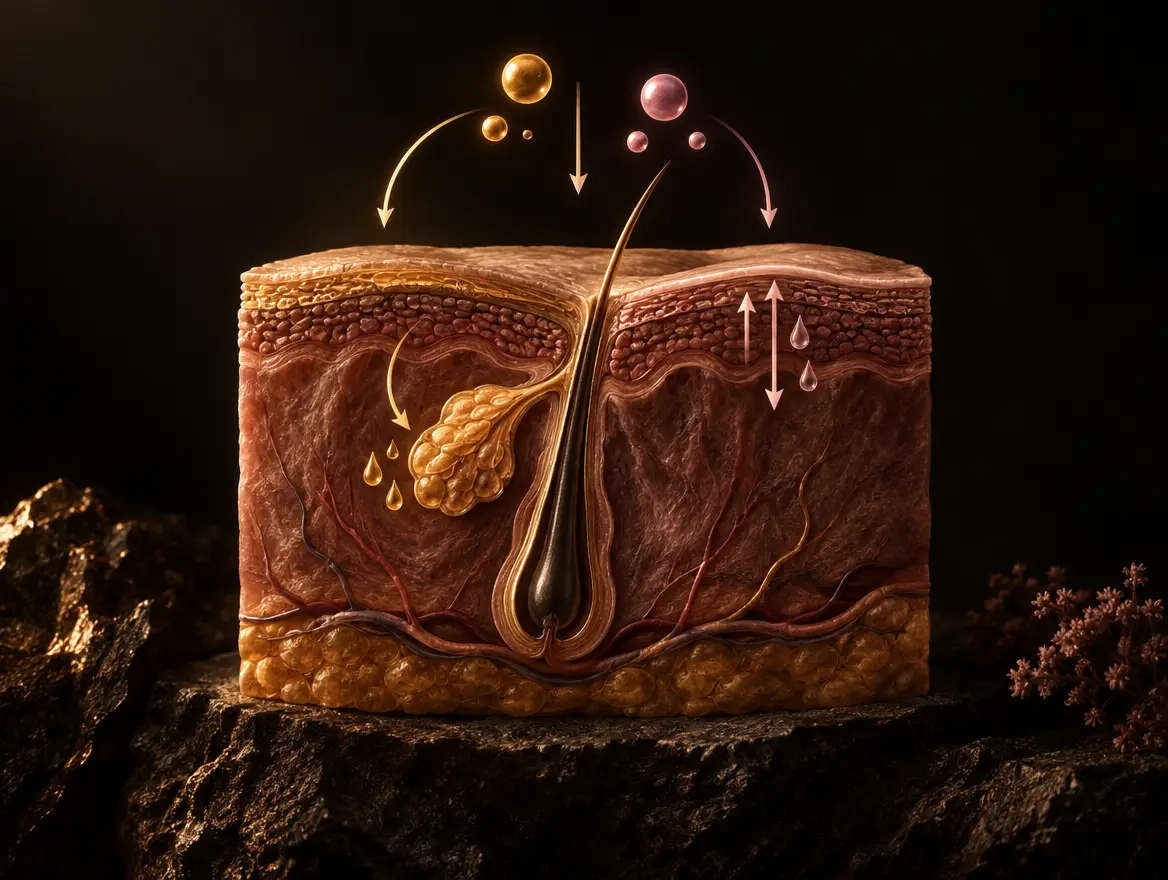
Breakouts can appear in perimenopause because hormones fluctuate unevenly, and skin responds. Oestrogen becomes less steady, while other hormones, including androgens, can have a relatively bigger influence on oil and congestion. At the same time, the skin barrier can lose some softness and moisture. The result is skin that is breaking out and dry at once.
Perimenopause is the transition before menopause. According to Healthdirect Australia, it can last for several years, and the hormone changes involved are not a smooth, predictable slide. Oestrogen and progesterone can rise and fall from month to month. That unevenness is part of why women describe skin that behaves differently from one week to the next.
Here is the plain-language version. Oestrogen is associated with skin that feels plumper and more moisturised. As it becomes less steady, many women notice menopause skin changes such as dryness, tightness, dullness and a more reactive feel. Meanwhile, the balance between hormones can shift in a way that affects how oily some areas feel. You can end up with a dry cheek and a congested chin on the same day.
We want to be careful here. Skin is individual, and we are not going to tell you exactly what is happening in your body. Hormones are one piece. Genetics, stress, sleep, the products you use and your general health all play a part. If you want a wider view of what tends to change and what to adjust, our guide to perimenopause skin changes and what to adjust is a good companion to this article.
One more point matters for how you care for your skin. Many women expect that breakouts mean skin is too oily and needs drying out. In perimenopause, that assumption is often wrong. The skin is frequently short on comfort and moisture, even where it is also producing some oil.
What Do Perimenopause Breakouts Look and Feel Like When Skin Is Also Dry?
Dry skin and breakouts together often look like small bumps or blemishes around the chin, jawline and cheeks, surrounded by skin that feels tight, rough or flaky. The blemishes can feel sore, and products that once felt fine may now sting. It is a mixed picture, which is why teen-focused advice rarely fits.
This is what women commonly describe when they search for adult acne in perimenopause:
- Breakouts concentrated around the lower face, often more noticeable around the time of the month
- A tight, uncomfortable feeling after cleansing
- Patches of flaking or roughness beside a blemish
- Skin that looks dull even when it is breaking out
- Redness or stinging from products that used to be fine
The contrast is the key detail. In your teens, breakouts usually came with skin that felt oily and resilient. In your forties, they can come with skin that feels thin, dry and easily upset. The same harsh product that your younger skin tolerated can leave your current skin red and sore.
That difference changes what a sensible routine looks like. Instead of asking how to dry the breakouts out, it is more useful to ask how to keep the rest of your skin comfortable while the breakouts settle. Start with how your skin feels today, not with what worked in your twenties.
Why Do Stripping Cleansers and Stacked Actives Backfire on Dry Skin?
Stripping cleansers and stacked actives often backfire because dry, reactive skin has less buffer. Each harsh step removes more of the oils and moisture the barrier relies on, and each added active raises the chance of stinging, redness and flaking. Irritated skin often looks and feels worse, which tempts people to add even more.
It is a loop many of us have been in. A breakout appears, so you reach for a foaming cleanser that leaves skin squeaky, then a strong exfoliating product, then a spot treatment, then a mask. Skin gets tighter and redder. It looks worse, so you add another step. Nothing in that sequence gives your skin a chance to settle.
Here is the logic behind our view. Skin that is drier and more reactive has less margin for error. When oestrogen falls, skin can become drier and more reactive, so stacking new actives raises the chance of irritation. Every strong product is a small stress on the barrier. One may be fine. Four at once, on skin that is already dry, is a lot to ask.
There is also a practical problem. When you change several things at the same time, you cannot tell what is helping and what is causing trouble. If your skin flares, which product was it? You end up guessing, and often you throw out the gentle products along with the harsh one.
The habits worth questioning are:
- Foaming or gritty cleansers that leave skin feeling squeaky or tight
- Scrubs and frequent exfoliation on skin that is already dry
- Several active products layered together in the same routine
- Very hot water, which adds to dryness
- Skipping moisturiser because breakouts make skin feel like it should be dried out
None of this means active ingredients are bad. It means skin that is dry and breaking out at the same time usually needs fewer, gentler steps first. If a particular active is right for you, a pharmacist, GP or dermatologist can help you choose it and introduce it safely.
What Does a Gentle Skincare Routine for Perimenopause Look Like?
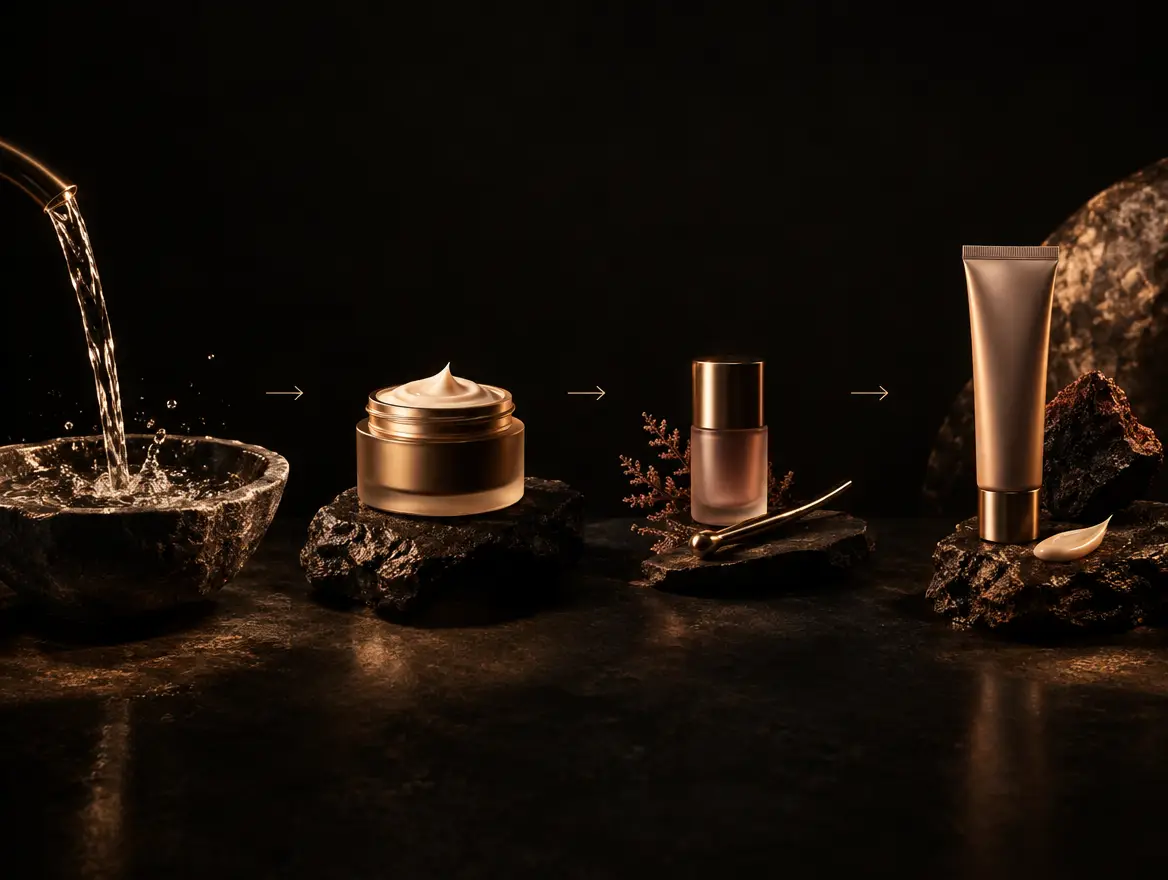
A gentle skincare routine for perimenopause needs only four things: a mild cleanse with lukewarm water, a comfortable moisturiser for face and neck, optional eye care, and daily broad-spectrum sunscreen. We call this a simple routine for changing skin. It works because each step is easy to judge and nothing competes with anything else.
Step 1: Cleanse gently
Use lukewarm water, not hot. Choose a mild cleanser that leaves your skin feeling comfortable, not tight. Use your hands rather than a scrubbing tool, and pat dry with a clean, soft towel. In the evening, cleanse to remove sunscreen and any makeup. In the morning, if your skin is very dry, a rinse with lukewarm water may be enough for you. Listen to how your skin feels.
A useful test: if your face feels squeaky or tight within a minute of cleansing, the cleanser is probably too much for your skin right now.
Step 2: Moisturise face and neck, morning and evening
A comfortable moisturiser is the centre of the routine. For dry skin that is also breaking out, comfort matters more than a long ingredient story. We designed the Truff'elle Face and Neck Cream (also called The Peptide Cream) for morning and evening use. It is built around bio-fermented Australian black truffle, with ingredients including Kakadu, Illawarra and Burdekin plum extracts, green tea, goji berry, sacha inchi and safflower oils, sodium hyaluronate and vitamin E.
We describe it by how it feels and looks on skin: moisture, comfort and a softer feel. We do not claim it treats breakouts, and it is not a spot treatment. Please also note that it contains fragrance (from Manuka honey). If your skin is sensitive or reactive to fragrance, patch test carefully, as covered below.
Step 3: Eye care, only if you want it
Eye care is optional. If you choose it, read the eye cream section further down first, because the Truff'elle Eye Cream contains retinol and needs a slower introduction.
Step 4: Protect daily with sunscreen
Sunscreen is the step most often skipped when skin feels sensitive or breakout-prone, and it matters. We suggest a broad-spectrum sunscreen on days when the UV index is 3 or above, which you can check on the Bureau of Meteorology or SunSmart app. The Cancer Council recommends SPF30 or higher broad-spectrum sunscreen as part of sun protection. If one texture feels heavy on your skin, try a different one rather than dropping sunscreen altogether.
Step 5: Patience
The last step costs nothing. Skin needs time to settle, and a routine needs time to be judged fairly. That brings us to how to add anything new.
How Do You Introduce One New Product at a Time?
Introduce one new product at a time by patch testing first, adding a single product, then waiting several weeks before judging it or adding another. Note how your skin feels in the same light each time. If irritation appears, stop and seek advice. Waiting is what lets you know which product is responsible for any change.
We call this approach one change at a time. It is the most useful habit we can suggest for skin that is dry and breaking out, because it replaces guessing with information.
How to patch test
- Choose a small area, such as the inner forearm or just behind the ear.
- Apply a small amount of the product as you would normally.
- Leave it, and watch the area over the next day or so for redness, itching, stinging or swelling.
- If anything appears, wash it off, do not use the product, and ask a pharmacist or doctor if it persists.
- If the area stays comfortable, begin using the product on your face, starting with a small amount.
A patch test is not a guarantee. It reduces the chance of a surprise, but skin can still react later, especially if it is already dry. Stay alert in the first few weeks.
What to watch for
- Stinging, burning or tightness soon after application
- New redness, itching or flaking
- A rash or swelling (stop using the product and seek advice)
- New bumps in an area that was previously clear
- Skin that feels more comfortable, softer and less tight (a good sign)
Why to wait before adding more
Several weeks is a fair window, because skin does not change overnight and perimenopausal skin can vary with your cycle, sleep and stress. Take a photo in the same light every week or two, if that helps you see subtle differences. Judge by how your skin feels as well as how it looks. If you add a second product after only a few days, you have lost the ability to tell what is working.
If you are new to a product and unsure, a smaller size is a sensible way in. The Truff'elle Face and Neck Cream is available as a 20mL Discovery size at $79 with the same formula as the full size, so you can try the texture and feel on your own skin before committing.
How Should You Use an Eye Cream With Retinol Around Breakouts?
The Truff'elle Eye Cream contains retinol, so it needs more care than a plain moisturiser. Use it only around the eyes, as directed, introduce it gradually, and wear sunscreen by day. Never use it as a spot treatment on breakouts. Retinol on an existing blemish or irritated patch is likely to cause discomfort rather than help.
This is worth stating clearly, because when breakouts appear it is tempting to dab whatever is on the shelf onto a blemish. Please do not do that with the Eye Cream. It is formulated for the delicate area around the eyes, and it is not intended for blemishes, the cheeks, the chin or the jawline.
The Eye Cream also contains acetyl hexapeptide-8, sodium hyaluronate, caffeine and black truffle extract. We describe it in cosmetic terms, as care for the eye area that supports a softer feel and the appearance of fine lines.
If you decide to add it:
- Patch test first, following the steps above
- Start gradually, using it less often at the beginning, and follow the directions on the pack
- Apply only a small amount around the eyes, as directed
- Use sunscreen by day
- Stop if your skin becomes irritated, and seek advice if it persists
- Keep it separate from any other new product you are trialling, in line with one change at a time
Retinol is also something to raise with a doctor or pharmacist if you are pregnant, planning a pregnancy or breastfeeding. If you have sensitive skin or an existing skin condition, check in with a professional before adding it. Our eye cream application guide goes into the technique in more detail.
What Else Makes Breakouts Worse?
Several everyday habits can make perimenopause breakouts feel worse, and most are easy to adjust. Touching your face, sleeping in makeup, heavy layered products, rough towels, stress and poor sleep can all add to congestion or irritation. Small changes here cost nothing and fit alongside a short routine.
You do not need to overhaul your life. Consider a few gentle adjustments:
- Hands off. Resting your chin in your hand or picking at blemishes can add irritation and delay settling.
- Remove sunscreen and makeup each evening. Gently, and without scrubbing.
- Wash pillowcases and towels regularly. Soft, clean fabrics are kinder to sensitive skin.
- Review your product count. If you are using many products, consider which ones you could pause, one at a time.
- Check your hair products. Heavy styling products can touch the jawline and forehead.
- Mind stress and sleep. Perimenopause often disrupts both, and many women notice their skin feels worse when they are tired. Be kind to yourself here.
What about diet and exercise? General healthy habits support wellbeing in perimenopause, and a GP or accredited practising dietitian can advise you personally. We would be cautious about any claim that one food will clear your skin, because the evidence for that kind of promise is mixed, and skin is individual.
When Should You See Your GP or a Dermatologist?
See your GP or a dermatologist if breakouts are painful, deep, cystic, scarring, spreading or not settling. Also check in if they arrive suddenly alongside other changes that worry you. Skincare is cosmetic care for comfort and appearance, and it cannot replace medical advice for a skin condition.
Breakouts that are deep, sore or leave marks deserve a proper assessment. So do breakouts that have lasted a long time despite gentle care, or that are affecting your confidence and daily life. There is no need to wait until it feels like an emergency.
A GP is a good first stop. They can look at your skin, ask about your cycle and other symptoms, and refer you to a dermatologist if needed. If you are experiencing other perimenopause symptoms, such as hot flushes, disrupted sleep or changes to your periods, it is worth raising those at the same appointment. Resources from Jean Hailes for Women's Health can help you prepare for that conversation, and the Australasian College of Dermatologists can help you understand what a dermatologist does.
If you notice swelling, a rash, or signs of infection such as spreading redness, heat or pus, seek medical advice promptly.
Why We Believe in a Shorter Shelf for Changing Skin
Our position is simple: perimenopausal and menopausal skin is usually better served by fewer, well-chosen steps, added one at a time, than by a crowded shelf. We hold that view because skin can become drier and more reactive as oestrogen falls, and every new active raises the chance of irritation.
This is not only a talking point. It is how Truff'elle was built. When Sabina Kelley found her skin changing in her forties, the problem was not a lack of products. She had plenty. The problem was that the routine she knew no longer felt right, and the market kept answering with more: more steps, more actives, more promises. She worked with Melbourne cosmetic chemist Raniya M. Bodoci to build the opposite. The core Truff'elle routine has 2 products, built around 1 hero ingredient: bio-fermented Australian black truffle. There are no extra steps added to make a bigger collection.
We also hold a second view that is unfashionable in skincare. Research on an extract is a starting point for formulation, not a promise from a finished jar. Results depend on the whole formula, how you use it and the person using it. That is why the brand makes 0 clinical percentage claims, and why we describe results by how skin feels and looks: moisture, comfort, a softer feel. These figures describe our range and positioning. They are not clinical results, and no clinical trial data has been published, so none should be implied.
The third view is about age. Women move through perimenopause and menopause at different ages and with different skin changes, so an age printed on a jar says little about your skin. How your skin feels today matters more.
For breakouts specifically, here is the contrarian part. If your skin is dry and breaking out, the most useful thing you can do is usually to remove something, not add something. Pause the extra step that stings. Keep the cleanse gentle, the moisturiser comfortable and the sunscreen daily. Then change one thing at a time. It is a little more understanding and a little less complication, for the years it changes. If it does not settle, that is your cue to get professional advice, not to buy more.
The Truff'elle Face and Neck Cream is one gentle, comfortable moisturising step in that kind of routine. It is not a breakout treatment, and we do not present it as one.
Simplify Your Routine
If your shelf has grown crowded and your skin is still unhappy, try taking a step back. Start with how your skin feels today, keep the routine short, and change one thing at a time. You can explore the Truff'elle Face and Neck Cream as a comfortable, gentle moisturising step, and try it first in the 20mL Discovery size.