Not always, but often it helps. The skin around your eyes is thinner and moves constantly, so a face cream can feel heavy or irritating there. If you want one extra step in perimenopause or menopause, a lightweight eye cream made for that zone is a sensible choice. If you want fewer steps, a gentle moisturiser may be enough.
Sabina Kelley, founder of Truff'elle, reached her forties and noticed her skin changing. It felt drier and less comfortable, and the luxury products she had relied on for years no longer felt right. Her shelf was full, but very little of it seemed made for changing skin.
That experience led to a deliberately small range: one face and neck cream and one eye cream. So when women ask whether an eye cream is worth it or just an upsell, we take the question seriously. This guide gives an honest answer for Australian women in perimenopause, menopause and the years beyond. It covers face cream vs eye cream, how retinol fits in, and how two well-chosen steps can work together. It is general information, not medical advice.
Key Takeaways
- An eye cream is optional. It earns its place when the eye area feels dry, tight or tired and your face cream is not quite right there.
- Face cream around the eyes is sometimes fine, but rich textures, fragrance and strong actives are not designed for that zone.
- A dedicated eye cream is usually lighter, used in small amounts and formulated for delicate skin.
- The Truff'elle Eye Cream contains retinol, so introduce it gradually, patch test first and wear sunscreen every day.
- Fewer steps, added one change at a time, suit changing skin better than a crowded shelf.
- Start with how your skin feels today, not an age printed on a jar.
The Peptide Cream to renew, hydrate, strengthen and protect. The Eye Cream for fine lines and tired looking eyes. Or both together in the Black Diamond Duo.
Summary Table: Your Eye Area Options
| Approach | Best suited to | What to watch for |
|---|---|---|
| Gentle moisturiser only, kept off the lash line | Women who want the fewest steps and find their eye area comfortable | Rich or fragranced creams may feel heavy or sting near the eyes |
| Face cream used around the eyes | Women whose face cream is light, gentle and well tolerated | Texture and actives are not designed for this zone |
| Dedicated eye cream without retinol | Women who want targeted comfort and a softer feel | An extra step and cost, so make sure you will use it |
| Dedicated eye cream with retinol | Women who want targeted eye care and will introduce it slowly | Patch test, evenings only at first, daily SPF, check with a doctor or pharmacist if sensitive |
| Sunscreen as your main eye care | Women who prefer the simplest possible routine | Sunscreen near the eyes can sting, so choose one you tolerate |
Why Is the Skin Around Your Eyes Different?
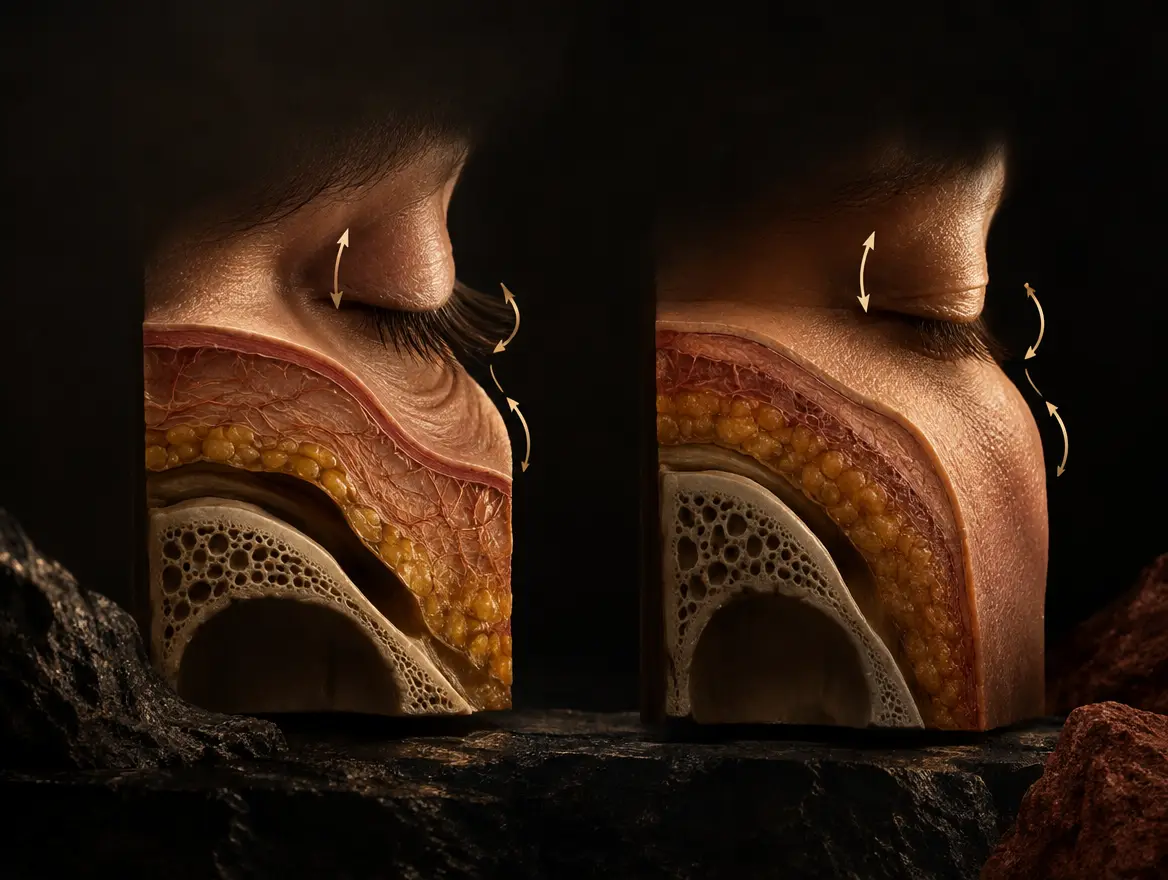
The skin around the eyes is thinner than on much of the face, and it moves every time you blink, squint or smile. As oestrogen declines, many women notice this area looking drier, more creased or more tired. That is a cosmetic observation, not a diagnosis.
There are three things going on here, and they are worth separating.
Thinner skin. The eyelids and the area beneath the eyes have delicate skin compared with your cheeks or forehead. Delicate skin tends to show dryness and fine lines sooner, and it can react more readily to products that sit comfortably elsewhere on the face.
Constant movement. You use the muscles around your eyes all day. Smiling, reading, squinting at a screen and sleeping all fold this skin repeatedly. Over the years, those folds become more visible.
Changing hormones. Many women describe their skin as drier and less comfortable during perimenopause and menopause. The eye area, already delicate, often shows it. Dark circles and puffiness are a separate matter. They can come from genetics, sleep, allergies or health conditions, and a cream will not necessarily change them.
This is why the question is not really about age. Women move through perimenopause and menopause at different times and in different ways. Our perimenopause vs menopause vs postmenopause skincare guide explains those stages in more detail. For now, the useful starting point is simple: start with how your skin feels today. If your eye area feels dry, tight or different from the rest of your face, that is worth paying attention to.
If you have swelling, a rash, persistent redness or a sudden change around your eyes, see your doctor rather than reaching for a cream.
Can You Use Face Cream Around Your Eyes?
Sometimes, yes. A gentle, light moisturiser is often fine near the eyes, and many women use their face cream there without trouble. But rich textures, fragrance and strong actives are not designed for this zone. They can feel heavy, travel into the eyes or cause irritation.
When it works, it usually works because the face cream is light and simple. When it does not, there are a few common reasons.
Richness. A cream that feels comforting on dry cheeks can feel greasy or heavy on the thin skin beneath your eyes. Some women find it sits on the surface or makes the area feel puffy by morning.
Migration. Eye-area skin is close to the eye itself. A rich cream applied right up to the lash line can drift with warmth and movement and sting.
Actives and fragrance. Face creams are formulated for a broader area and a broader job. They may include fragrance, plant extracts or active ingredients that are well tolerated on the cheek but less so near the eyes. Our own face and neck cream, The Peptide Cream, contains fragrance (Manuka honey) and a range of plant extracts. That suits the face and neck, and it is the reason we suggest using the eye cream for the eye area instead.
A practical rule. If you want to use face cream around your eyes, apply a small amount along the bone that frames the eye, not on the lids or lash line. Stop if you feel stinging or notice redness, watery eyes or swelling. If you have sensitive skin, patch test a new product behind the ear or on the inner forearm first.
This is the honest answer to face cream vs eye cream. It is not that face cream is wrong. It is that a product built for the whole face cannot be tuned for the most delicate part of it.
What Does a Dedicated Eye Cream Do Differently?
A dedicated eye cream is usually lighter in texture, made to be used in small amounts and formulated with delicate skin in mind. It tends to focus on comfort, a softer feel and the appearance of fine lines, rather than the broader job of a face moisturiser.
Three differences matter in practice.
Texture. Eye creams are generally lighter and absorb more readily, so they are less likely to feel heavy or slide towards the eye.
Placement and quantity. An eye cream is meant to be dotted and patted lightly along the orbital bone, using very little. That targeted approach is part of what makes it different from smoothing a moisturiser over the whole face.
Formula choices. The ingredient list is chosen for the area. The Truff'elle Eye Cream (20mL) contains retinol, acetyl hexapeptide-8, sodium hyaluronate, caffeine and black truffle extract. Sodium hyaluronate is a moisture-binding ingredient used for hydration and a plumper feel. Caffeine and peptides are common in eye-focused formulas. We describe the benefits in cosmetic terms only: comfort, a softer feel and the appearance of fine lines.
We formulate with an approach we call Master Key, developed with Raniya, Principal Cosmetic Chemist at Bodoci Biophysics Research & Development Group, in Melbourne. It is built around bio-fermented Australian black truffle, and it covers ingredient choice, how ingredients combine and how the finished cream feels. It is an approach, not a proven mechanism.
One thing we are careful about: research on an extract is a starting point for formulation, not a promise from a finished jar. Results depend on the whole formula, how you use it and the person using it. That is why we make 0 clinical percentage claims and do not present ingredient-study numbers as results from our products. No clinical trial data has been published for the range, and we would rather say so plainly.
For a general overview of choosing and using eye cream, Cleveland Clinic's guide is a useful independent read (linked in the references below).
So, Do You Actually Need an Eye Cream?
No, an eye cream is optional. Plenty of women do well with a gentle cleanse, a comfortable moisturiser and daily sunscreen. An eye cream earns its place when the eye area feels dry, tight or looks tired in a way your face cream does not address, and you are happy to add one step.
Here are three honest questions to ask yourself.
- Does your eye area feel dry or tight by midday, even after moisturising? If yes, a lighter, targeted product may help.
- Does your face cream sit comfortably near your eyes, or does it sting or feel heavy? If it does not, a dedicated eye cream solves a real problem.
- Will you use it consistently? An eye cream used twice and forgotten is just an expensive jar.
If you answer no to all three, you probably do not need one yet. Put your effort into sunscreen and a moisturiser you enjoy.
It is also worth knowing what an eye cream will not do. It will not remove dark circles caused by genetics, and it will not fix puffiness caused by sleep, allergies or health conditions. It is a cosmetic product. Used well, it can leave the area feeling more comfortable and looking smoother and better cared for.
The upselling concern is fair. Beauty shelves are crowded, and women in midlife are often told to buy more. Our position is the opposite. Perimenopausal and menopausal skin is usually better served by fewer, well-chosen steps, because skin can become drier and more reactive as oestrogen falls, and stacking new actives raises the chance of irritation.
Is a Retinol Eye Cream Suitable for Mature Skin?
The Truff'elle Eye Cream contains retinol, so it suits women who want targeted eye care and are comfortable introducing it slowly. Start a few evenings a week, patch test first, wear sunscreen every day, and check with a doctor or pharmacist if your skin is sensitive or you have concerns.
Retinol is a vitamin A derivative widely used in cosmetic skincare, and it is also known for causing dryness or irritation if introduced too quickly. On skin that is already drier and more reactive, that matters. We cover how retinol and truffle skincare compare in a separate guide, Truffle Skincare vs Retinol, so we will not repeat it here. What follows is the practical side.
Our approach: one change at a time.
- Patch test first. Apply a small amount behind the ear or on the inner forearm and watch for a reaction before using it near your eyes.
- Introduce one new product at a time. Do not start a new eye cream in the same week as a new cleanser or serum. If something irritates, you will not know the cause.
- Start with a few evenings a week. Use the eye cream at night, then increase only if your skin feels comfortable.
- Give it several weeks. Note how your skin feels and looks in the same light, in the same spot, rather than judging from one mirror on one day.
- Stop if irritation occurs. Persistent redness, stinging or swelling is a signal to stop and ask for advice.
Sunscreen is not optional. Use broad-spectrum sunscreen by day. In Australia, the Cancer Council's SunSmart programme recommends sun protection when the UV index is 3 or above, and that is the case across much of the country for large parts of the year. Check the UV index in the SunSmart app or on the Bureau of Meteorology website.
Who should check first. Talk to a doctor or pharmacist before using a retinol product if you are pregnant, planning a pregnancy or breastfeeding. Do the same if you have very sensitive skin, a skin condition such as eczema or rosacea, or you are using prescription skincare. If retinol does not suit you, a non-retinol eye product may be a better fit, and that is a perfectly good choice.
How Do a Face and Neck Cream and Eye Cream Work as a Two-Step Routine?
The face and neck cream looks after your face and neck morning and evening, while the eye cream gives the delicate eye area its own targeted care. Together with gentle cleansing and daily sunscreen, that makes a simple menopause skincare routine that is easy to keep up.
We call it a simple routine for changing skin:
- Cleanse gently with lukewarm water and a mild cleanser.
- Moisturise your face and neck morning and evening. For us, that is The Peptide Cream (50mL).
- Add targeted eye care if you want it. The Eye Cream contains retinol, so introduce it gradually.
- Protect daily with broad-spectrum sunscreen when the UV index is 3 or above.
The core Truff'elle routine is 2 products: the face and neck cream and the eye cream. It has 1 hero ingredient, bio-fermented Australian black truffle. Those figures describe the range specification, not a clinical result. We keep it deliberately small because every extra step is another chance for irritation and another thing to remember.
In practice, a day looks like this. In the morning, cleanse, apply the face and neck cream, then sunscreen. In the evening, cleanse, apply the face and neck cream and, a few evenings a week, a small amount of eye cream.
Add one at a time. You do not have to start with both. Many women begin with the face and neck cream and add the eye cream a few weeks later once they know how their skin feels. A smaller 20mL Discovery size of the face and neck cream (same formula, $79) lets you try the texture and routine before committing to the full 50mL ($227). The Eye Cream is $207 on its own, and the Black Diamond Duo ($397) pairs the 50mL cream with the 20mL eye cream. Full-size products ship free worldwide. These are our own prices, not third-party figures.
Quick Answers: When to Start, Morning or Night, and How Much
Start when your eye area begins to feel dry or different, not at a set age. Use a retinol eye cream in the evening, a few nights a week at first, with a very small amount patted along the bone around the eye. Wear sunscreen every morning.
When to start. There is no magic birthday. Some women notice changes in their forties, others later. If your eye area feels dry, tight or tired, and your face cream is not quite right there, it is a reasonable time to consider an eye cream.
Morning or night. Because the Truff'elle Eye Cream contains retinol, we suggest evenings, with sunscreen the next day. Keep mornings simple: face and neck cream, then sunscreen.
How much. Less than you think. A grain of rice worth of product for both eyes is a sensible starting point. Dot it along the orbital bone and pat gently with your ring finger, which applies the lightest pressure. Do not pull or rub the skin. We go through technique step by step in our guide, How to Apply Eye Cream Properly.
Why the Eye Cream Question Is Really a Shelf Question
In our experience, women asking whether they need an eye cream are usually asking a different question: how many steps is too many? The answer for changing skin is fewer than the industry suggests, and a single added step should earn its place.
This is our genuine position, and it runs against much of the beauty industry. The common view is that changing skin needs more products and stronger actives. We think the opposite. Consider a woman in her early fifties with a crowded bathroom shelf: two cleansers, three serums, a day cream, a night cream and an eye gel. Her skin feels tight, and she assumes she needs something stronger. In a situation like that, the more useful move is usually to subtract, not add. Simplify to a gentle cleanse, a moisturiser that feels comfortable and daily sunscreen. Then add one thing, such as an eye cream, and watch how skin feels over several weeks.
That is also how Truff'elle began. Sabina found her skin drier and less comfortable in her forties, and her old routine stopped feeling right. She did not want a bigger collection. She built a focused range with Raniya Bodoci: one face and neck cream and one eye cream, with no extra steps for the sake of it.
We also think the premium end of skincare asks too much too soon. Skin in this life stage can be sensitive and unpredictable, and it is a real barrier to ask women to commit to full-size, premium-priced products before they know whether they suit. That is why we offer the Discovery size. You judge the range by how your skin feels in daily use, not by a promise on a label. We make no sales or conversion claims here, only that it lets you try before you commit.
If you take one idea from this article, take this: pick skincare by how your skin feels today, not by the age printed on a jar. Then change one thing at a time. A little more understanding, a little less complication.
If you would like to try a simple, considered routine for the years it changes, explore the Black Diamond Duo: the face and neck cream and eye cream together.